By Nathaniel Zaccheaus, Abuja
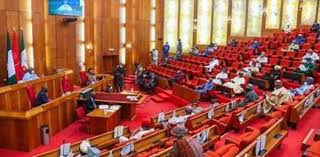
The Senate on Thursday grilled the federal government over the assumptions underlying the proposed N58.472 trillion 2026 Appropriation Bill, warning that the budget could be reduced if key revenue projections fail to withstand scrutiny.
The lawmakers, during a tense session with members of the federal government’s economic team at the Senate Committee on Appropriations, raised concerns over what they described as unrealistic revenue targets, persistent oil performance shortfalls and rising debt exposure.
Chairman of the committee, Senator Solomon Adeola (Ogun West), said discrepancies between projected and actual oil revenues in recent years had cast doubt on the credibility of current projections.
“The challenges in this document emanated from the executive, not the legislature,” Adeola said. “How do we explain such underperformance? Do we reduce this budget or leave it as it is? If we are not reducing it, then you are telling Nigerians you will meet the targets.”
He noted that with Nigeria’s debt stock estimated at N152 trillion and debt servicing already consuming a significant portion of government revenues, the National Assembly would be reluctant to approve projections that could worsen the fiscal situation.
Adeola also demanded clarification on whether the revenue projections presented were for the entire federation or strictly for the federal government, warning that vague figures could complicate legislative approval.
*Finance Minister defends figures, cites economic recovery
Responding, the Minister of Finance and Coordinating Minister of the Economy, Mr Wale Edun, defended the budget’s assumptions, particularly the oil production benchmark of 1.84 million barrels per day.
He described the figure as a deliberate target intended to drive improved performance.
“It is a stretch target so that authorities do not settle for lower output. But as long as we do not spend what we do not have, we are within safe limits,” Edun said.
The Minister also disclosed that security spending had been prioritised, with emergency funds released for critical military procurements, including foreign acquisitions.
“We all agree that security must be prioritised. Emergency funding has been given. Critical foreign payments for security equipment have been made at least twice this year, including as recently as yesterday,” he said.
On the issue of rising debt, Edun argued that Nigeria’s main challenge was not the size of its debt relative to GDP but the high interest rates faced by developing countries in global financial markets.
He added that Nigeria was currently chairing a G24 technical group meeting where debt sustainability and borrowing costs were major concerns, stressing that the government remained committed to fiscal discipline.
Edun further stated that the economy was showing signs of recovery, with growth approaching four per cent, inflation easing, foreign reserves improving and exchange rate stability strengthening.
He also cited renewed investor confidence, including a reported $20 billion investment commitment by Shell.
However, Chairman of the Nigeria Revenue Service, Dr Zacch Adedeji, cautioned against overambitious budgeting, stressing the importance of aligning projections with realistic revenue expectations.
“Budget efficiency is not about the quantum of the budget; it is about what you can implement,” Adedeji said.
“If we think we have 10 naira and we plan with 100 naira in mind, we will create problems for ourselves.”
He explained that government oil revenues under the Petroleum Industry Act are largely derived from taxes and royalties, noting that high production costs significantly reduce net earnings.
According to him, about 47 per cent of oil company output translates into government revenue under the current arrangement.
Lawmakers also raised concerns about poor capital releases in previous budgets, particularly in the 2024 and 2025 appropriations, which they said showed weak implementation.
In response, the Minister of State for Finance, Dr Doris Uzoka-Anite, assured the committee that outstanding capital releases would be addressed.
She said payments for 2024 capital projects would commence immediately, while Ministries, Departments and Agencies had been directed to upload their cash plans to enable disbursements for the 2025 budget.
“The financial management system is back online. We are ready to start, but MDAs must complete their documentation requirements,” she said.
The meeting later went into a closed-door session attended by key officials, including the Minister of Budget and Economic Planning, Senator Atiku Bagudu, and the Accountant General of the Federation, Shamsedeen Ogunjimi.
The Senate’s position signals that unless the federal government provides convincing justifications for its projections, the National Assembly may revise the N58.47 trillion budget proposal in line with fiscal realities.