Nigeria needs fresh leaders, not ‘expired’ political elites — Adebayo

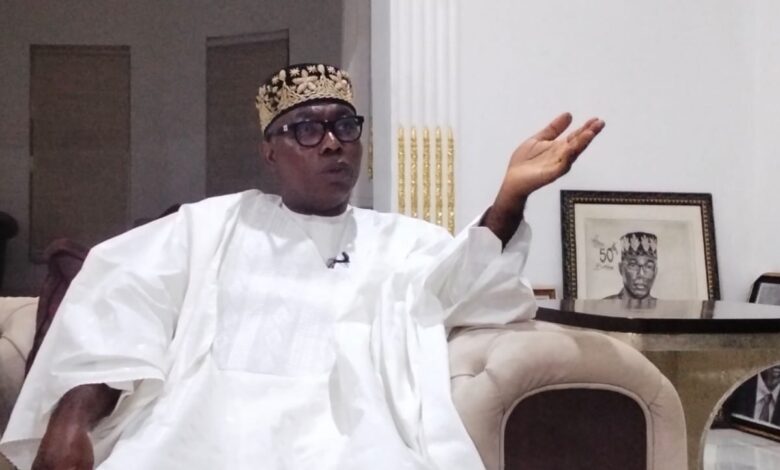
Prince Adewole Adebayo, leader of the Social Democratic Party (SDP) and its 2023 presidential candidate, delivers a scathing assessment of Nigeria’s political class, describing it as recycled and out of touch with the people. In this interview with David Lawani, he dismisses claims of a shrinking opposition, insists that democracy must be measured by citizens’ welfare, not political defections, and lays out his vision for a fundamental reset ahead of the 2027 general elections
The APC continues to consolidate power nationwide. Does this not suggest that the opposition space is shrinking ahead of the 2027 general elections?
There is no shrinking opposition space. It depends on how you define democracy: whether you see it as a game among public officeholders or as a system driven by the people. Democracy, as it should function, is determined by the majority sentiment of the electorate. What we are seeing today is a flawed obsession with incumbency, treating governors, senators, and the president as if they define democratic strength. That is not how democracy works anywhere in the world. In a healthy democracy, what matters is whether the people feel hopeful about the future, approve of the government’s performance, and align with its direction. The media should stop focusing on incumbents and instead listen to ordinary Nigerians. It does not matter how many governors you have, whether acquired legitimately or otherwise. What matters is whether citizens feel better governed, feel properly led, and support the direction of leadership. If you assess governance using those metrics, you will see that the current administration and incumbents are in serious trouble.
How do you view the SDP not being part of coalitions like the ADC, which is aligning with other parties to challenge the APC in 2027?
That is not relevant to me; it is largely a media-driven narrative. My concern is that any political position I take must align with the will of Nigerians, the constitution, and the founding objectives of this country. If all 36 governors decide to move to one party, that is not my business. I have been in the SDP since 1991, and I am not going anywhere. Others may be more mobile, moving from one platform to another, that is their style, not mine. There is also hypocrisy in how defections are treated. People complain when governors move to another party, yet celebrate when lawmakers cross over to their side. What matters is the quality of those defecting. Are they moving with the people? Do they have credible performance records? Across Nigeria, you will find no state that is fully secure, economically stable, or free from corruption issues. These incumbents share a record of underperformance. If they all gather in one place, it does not concern me. As for opposition dynamics, Nigeria is not a parliamentary system. The idea of copying the APC’s strategy of absorbing politicians is misguided. The SDP has always maintained that many of these parties are interconnected, a relay of failure passing the baton from one administration to another. What we are building in the SDP is different. We are focused on ideological clarity, constitutional alignment, especially Chapter Two on fundamental objectives, and genuine social investment. We are not interested in personality-driven politics or opportunistic alignments.
What specific style of politics is the SDP rejecting?
We reject the politics of hypocrisy. For instance, someone can spend 20 years in the Senate, participate in multiple electoral reforms, even serve as Senate President, and still fail to improve electoral transparency or credibility. Such individuals had the opportunity to act but did nothing. Yet, once they are out of power, they begin to criticise the same system they failed to fix. The same applies to those who held positions like Attorney General without strengthening the rule of law, only to become vocal critics afterward. That is not the kind of politics we want. We reject politics without principle, where loyalty shifts based on personal advantage. In the SDP, we are not seeking defectors from the National Assembly. Instead, we support a complete reset through movements like FixNASS, advocating that most incumbents should not return. After decades of budget approvals with little to show, Nigeria needs a new crop of legislators, patriotic, competent, and independent-minded. We want a fundamental shift in politics, not a recycling of failure.
Why should Nigerians trust a relatively smaller party like the SDP over larger, more established parties?
The problem is deeper than party size. Nigeria lacks a true political class. What we have is a group of individuals driven by desperation to be in government. The APC itself is not the root problem but a symptom, a coalition formed out of political convenience rather than ideology. People with no shared principles came together simply to gain power. Some politicians abandoned the PDP when it began to decline, joining new alliances out of self-interest. This pattern shows that these parties are not driven by ideas but by access to power. What Nigeria needs is not another alliance of convenience, but a fresh approach, bringing in credible, patriotic individuals with proven integrity. The current political class has little to offer.
Many voters struggle to distinguish ideologically between the SDP, APC, and ADC. How do you respond?
Nigerians are not confused; politicians are the ones avoiding real issues. People care about security, jobs, healthcare, and education, not personality attacks or ethnic and religious divisions. If you address Nigerians’ real concerns and present clear solutions, they will understand the difference. In the SDP, we emphasise credible elections, electronic transmission of results, INEC’s independence, and policies that directly address insecurity and poverty. These are the issues Nigerians pray about daily. That is what distinguishes us.
What is your view on the current system of party primaries?
The current system has its flaws, and President Tinubu missed an opportunity to strengthen electoral laws. However, democracy cannot depend on one individual. History shows that Nigerians have overcome flawed systems, from colonial rule to military regimes. The key factor is public participation. If Nigerians remain disengaged, democracy will not thrive. But if they are active, change is possible regardless of structural challenges.
Does the situation around Peter Obi and the ADC reflect disorganisation within the opposition?
Democracy should not revolve around individuals. The movement of one politician from one platform to another is not the central issue. What matters is building a system that serves the people. Personal political movements are secondary.
You have been critical of the current administration. On what basis?
Governance must be assessed based on outcomes. If economic policies are not creating jobs, if insecurity persists, and if ministers cannot access budgetary allocations effectively, then something is wrong. The next president must engage more deeply with the people and secure a broad mandate. I want to lead with at least 40 million votes—not a narrow mandate—because the challenges ahead require collective ownership.
Do you believe you have what it takes to lead Nigeria?
You can only lead effectively if you align with people’s needs. I believe I understand those needs, but leadership must be earned, not seized. We are advocating for greater voter participation, at least 75 per cent turnout, so that leadership reflects the true will of Nigerians.
Will you contest the 2027 presidential election?
Yes, by God’s grace. I have informed my party of my intention to contest and to win for the Nigerian people. Beyond my ambition, 2027 must mark a turning point. Nigeria cannot continue with rising insecurity, poverty, and failing infrastructure. We must change direction and build a system where citizens are proud of their leaders.
At what point does criticism become alarmism that could weaken public confidence?
The responsibility to build confidence lies first with the government. When a government fails to deliver, the opposition must speak. That is not alarmism; it is accountability.
What indicators support your claim that the current government is failing?
Governance can be measured. If performance remains poor over time, excuses are no longer valid. Like a student repeatedly failing exams, you cannot claim to be new after several years. The government must deliver within its tenure. Pointing out failure early is more constructive than waiting until the end.
Are you suggesting that the president’s travels reflect leadership failure?
Not necessarily, but frequency and timing matter. Leadership requires presence and coordination. When the president is absent and governance gaps become obvious, it raises concerns about institutional strength and effectiveness.
Does the SDP have the financial capacity to compete in 2027?
We do not believe in money politics; we believe in people-driven politics. With a broad base of legitimate supporters, funding isn’t our challenge. We have contribution limits to prevent undue influence by large donors. Our focus is on credible elections, free from vote-buying, rigging, and violence. That is the only way to restore confidence in the democratic process.