By Cross Udo, Abuja
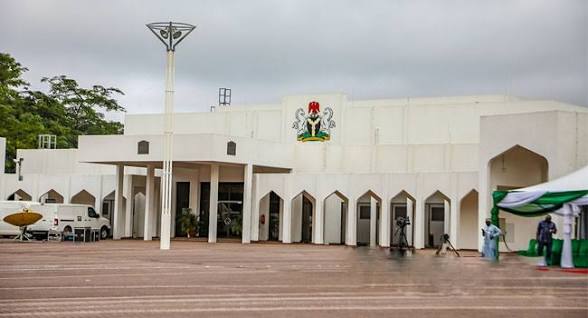
Entrance and exit gates of the Presidential Villa, Abuja, were on Thursday beefed up with watertight security to prevent any invasion by external elements amid an alleged planned protest over the unresolved kidnapping of schoolchildren in Oyo State.
Security agents, including the police, operatives of the Department of State Services (DSS), and the military, mounted roadblocks to screen people entering the villa.
State House staff had to show their identity cards to gain entrance to the villa, although there was no harassment.
As early as 8:00 a.m., vehicles heading to the villa from various entry points were subjected to thorough screening, with stringent checkpoints deployed at both the Asokoro and Federal Secretariat axes.
The lockdown caused significant traffic disruptions across Abuja as security forces tightened measures in anticipation of the demonstration.
Although no official reason was given for the development, the restrictions may be connected to Omoyele Sowore’s Wednesday ultimatum to President Bola Tinubu to ensure the release of the kidnapped pupils in Oyo State.
The human rights activist had declared, “We’ll march to Aso Villa on Thursday if abducted Oyo pupils are not rescued.”
He had given the government until Thursday to secure the release of approximately 46 pupils and teachers abducted on May 15 from schools in Oriire Local Government Area of Oyo State.
Sowore, presidential candidate of the African Action Congress (AAC), blasted President Tinubu for what he described as government negligence, declaring, “You can’t claim to be president and not do your job.”
He accused the federal administration of failing to protect Nigerian citizens amid escalating kidnappings and insecurity across the country.
The Oyo State abduction has sparked widespread public outrage, with the National Union of Teachers (NUT) launching nationwide protests demanding the children’s release. Sowore joined existing protests by Oyo residents and teachers who have been demanding action from the government.
“This is not about hype or social media grandstanding. This is about the life of children,” Sowore emphasised, countering criticism that his protest was merely for publicity.
The protest threat comes amid growing frustration over insecurity in Nigeria, with citizens increasingly demanding stronger government action against kidnappers and improved protection for vulnerable populations, including schoolchildren.
*IGP, NASS fine-tune framework for State Police
Meanwhile, the Presidency on Thursday met with the leadership of the National Assembly and the Inspector-General of Police, IGP Tunde Disu, to fine-tune the framework for establishing state police amid the heightened security situation in the country.
The National Assembly was represented by the Deputy President of the Senate, Jibrin Barau and the Deputy Speaker of the House of Representatives, Benjamin Kalu.
The meeting, according to the Special Adviser to the President on Information and Strategy, Bayo Onanuga, recorded significant progress towards establishing state police, with a constitutional amendment expected soon.
This is the result of months of consultations among the Executive, the National Assembly, and security authorities.
The Chief of Staff to the President, Rt. Hon. Femi Gbajabiamila, briefed State House correspondents after a consultative meeting on state police convened by the Presidency, at the State House, Abuja.
Gbajabiamila said deliberations on the proposed state police framework began several months ago following a directive by President Bola Ahmed Tinubu, noting that the process has gained considerable traction.
He explained that establishing state police requires careful consideration of constitutional and legal issues and cannot be implemented hastily.
He said, “We started deliberations in the last three or four months on how to go about the establishment of state police as directed by Mr President.
“Establishing state police is not something that you do with the snap of the fingers. There is a lot involved in terms of constitution and legalities, and thank God we have now gained significant traction.
“Hopefully, the amendment will come shortly, and the details of the amendment will come after that.”
According to him, discussions have now advanced to the point of considering the necessary constitutional amendments, with the enabling legislation to follow afterwards.
“Right now, what we are looking at is the constitutional amendment itself, and then the enabling law would follow thereafter. That is what we have been deliberating on in the last couple of hours,” he added.
The Chief of Staff highlighted broad national support for the initiative, emphasising that the debate is no longer about whether state police should be established but about creating the appropriate legal and institutional framework for its operation.
He said President Tinubu, who has consistently advocated for state police as part of efforts to strengthen Nigeria’s security architecture, would receive a comprehensive report on the meeting’s outcome.
The meeting is part of a series of consultations convened by the Federal Government to develop a workable framework for establishing state police, an initiative aimed at strengthening internal security, improving local intelligence gathering, and enhancing the capacity of sub-national governments to address emerging security challenges across the country.
Tinubu has maintained in the last few months that state police is a necessary response to Nigeria’s evolving security challenges, advocating that a decentralised policing structure would strengthen grassroots security, enhance intelligence gathering and improve the protection of lives and property across the country.
Senior government officials also attended the meeting.