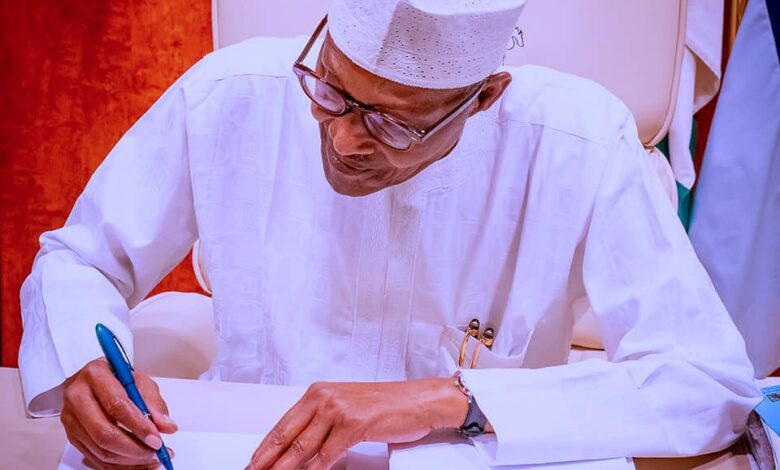
Members of the National Assembly ought to heave a sigh of relief after President Muhammadu Buhari assented to the Petroleum Industry Bill (PIB) on 16th August 2021, but they can’t do so to the extent that many Nigerians and interested stakeholders have joined issues with the legislature and the president over the new petroleum industry regulations.
The Act provides for legal, governance, regulatory and fiscal framework for the Nigerian petroleum industry, the development of host communities and related matters.
Now, it helps a lot to remember that the PIB had gathered dust in the recess of the Assembly for almost two decades since it was first introduced.
Mercifully, the 9th Senate-Assembly passed the controversial bill on 15th July 2021, while its House of Representatives counterpart okayed it the day after.
It thus makes the reason that we read and interprets the passage of the bill in the light of this background, otherwise, one may miss some important nuisances and undercurrent as the legislature and the presidency discharge the great deed they are called upon by Nigerians and history to fulfil.
When the present Assembly took on the great job of the task of giving Nigeria a new petroleum industry legislation with patriotism, it was clear that Nigerians and, indeed, most stakeholders extended sufficient goodwill to the lawmakers.
Why the storm over the petroleum industry legislation? Simple. Some little foxes, if you like, demons, as the Senate President, Ahmad Lawan, often refers to the unseen ugly guests, entered the hallowed chambers and turned a fresh apple chart into a can of worms, which the Assembly, the presidency, Nigerians, and interested stakeholders will grapple with.
From what has transpired so far, it could be safely said that the vision of the present administration to give Nigeria a new framework for the petroleum industry has become, rightly or wrongly, a matter the present leadership has to revisit.
A floodgate of criticisms against the Act was spontaneous, amidst some kudos for the government for breaking the PIB jinx.
Ezekwesili to teach Democracy, Africa’s Political Distortions at Yale University
But if the administration thought that the passage and signing of the PIB with a clause for provision of 3 per cent host communities trust fund in the Act would go without a whimper, they have been proved terribly wrong.
The new law provides fertile land for those who have stories to tell about the All Progressives Congress (APC) government to take more steps.
The most daring of these are, so far, in no particular order, Mike Ozekhome (SAN); Governor Nyesom WiKe of Rivers State; Senator Seriake Dickson; Chief Edwin Clark; the leading opposition party, the People’s Democratic Party (PDP); its young rival, the Action Democratic Party (ADP); the Southern Governors Forum; leaders of the South-South region and the Pan Niger Delta Forum (PANDEF), among others, top the bill.
Fiery lawyer and human rights advocate, Ozekhome, hit the Federal Government almost below the belt. He did not just accuse the government of impunity and giving the nation an Act deliberately designed by state captors to further egoistic self-interests, but added that the present administration had questions to answer concerning some provisions in the new law and the 1999 Constitution.
According to the Senior Advocate of Nigeria (SAN), the Act constitutes a direct assault on age-long cherished principles of federalism and the doctrine of separation of powers.
He added that to the extent that it seeks to redesign the constitution, the Act could be declared unconstitutional and abrogated with the sledgehammer of provisions of Section 1(3) of the 1999 Constitution.
The erudite lawyer, in a statement, noted that the PIB was never designed to reform any institution such as the NNPC, but to frontally attack the provisions of Section 162 of the constitution which states all revenue accruing to the Federation shall be paid into a Federation Account from which sharing shall be made amongst the three tiers of government.
“The panacea? Simple. The 36 states attorneys-general should immediately approach the Supreme Court and challenge the latest Federal Government’s impunity and the outrageous acts of executive lawlessness and legislative rascality we are beholding, invoking the Supreme Court’s original jurisdiction under Section 233 (1) of the 1999 Constitution,” he submitted.
On other hand, President Buhari said Nigeria lost an estimated $50 billion worth of investments in ten years as a result of the uncertainty of the non-passage of the PIB, lack of progress and stagnation in the petroleum industry.
Buhari noted that his assent to the bill last Monday marked the end of decades of uncertainty and lack of political will on the part of past administrations to actualise the needed transformation in the petroleum industry.
The president lauded the leadership and members of the 9th Assembly for their continued pursuit of national aspirations and demonstration of mutual harmony with the executive in the pursuit of patriotic outcome in the passage of the PIB.
As the diatribe continues, not a few are of the opinion that since the implementation of the Act will not commence fully, at least, in the next six months, the review of the contentious sections of the law should be undertaken before it goes the whole hog.
Gov. Ugwuanyi returns from Abuja, visits hospitalised survivors of adulterated kerosene
Rather than allow the provisions of the Act to prove counterproductive, the National Assembly should do the needful again.
This will take the wind off the sail of concerns that the passage of the PIB was incubated in bad blood. The fears will assume a life of their own, over time, if the legislature and presidency never bothered to seek a review of the Act, or sustain vigorously counter-narratives.
There is relative peace in the Niger Delta. Whatever narrative or counter-narrative is put forward, no one enjoys ignoble and reckless attacks or violence in the region or anywhere in the country.
If the government is finding it difficult to properly put its acts together against insurgents and bandits, an additional problem in the Niger Delta is, to put it mildly, amounts to fighting on all fronts simultaneously.
The Senate President has been captured on tape assuring that the petroleum Industry legislation is not sacrosanct. This is why the government should make a spirited move to amend the Act and give the nation’s economy and polity a new lease of life.
Since leaders of the South-South region and others have started raising concerns that the PIA may be an invitation to militancy in the creeks among other dangers, their concerns shouldn’t be dismissed as untenable.