The recent EndSARS protests nationwide and the five-point demands of the youths have clearly signposted the general economic situation in the country.
Aside from the general police brutality the youths sought to end, they invariably brought to the front burner the fact that they remain the worst hit by unemployment and underemployment; two critical factors that underpin an economy.
Indeed, the recent figures from the National Bureau of Statistic, NBS, on various economic indices for the second quarter of this year (Q2, 2020) painted a grim picture of unemployment and underemployment. The total number of persons in the economically active or working-age population (15 – 64 years of age) was 116,871,186, while the labour force (i.e. people within ages 15 -64, who are able and willing to work) was estimated to be 80,291,894.
The unemployment rate during the period was 27.1%, up from the 23.1% recorded in Q3, 2018. The underemployment rate increased from 20.1% in Q3, 2018 to 28.6%.
In, Q2, 2020, the unemployment rate among young people (15-34years) was 34.9%, up from 29.7%, while the rate of underemployment for the same age group rose to 28.2% from 25.7% in Q3, 2018. These rates were the highest when compared to other age groupings. NBS figures meant that over 13.9 million people aged between 15 and 34 years are unemployed.
The data also indicated that about 12.2 million women were out of jobs from the 27 million currently unemployed.
Graduates and postgraduates accounted for about 2.9 million of the total Nigerians that are jobless. Unfortunately, unemployment arising from a constricting economy is one of Nigeria’s major problems today.
Everywhere in the land, manufacturing concerns are giving out their properties to religious worship centres while revenues accruing to the three tiers of government have been on the decline since the first quarter of this year when the coronavirus pandemic hit the country.
Since then, there had been a collapse in oil prices. A recent World Bank Nigeria Development Update report titled “Nigeria In Times of COVID-19: Laying Foundations for a Strong Recovery” noted that Nigeria’s economy could contract by 3.2% in 2020.
This is on the assumption that the spread of COVID-19 in Nigeria is contained by Q3, 2020. If the spread of the virus becomes more severe, the economy could contract further.
The report said oil accounts for more than 80% of Nigeria’s exports, 30% of its banking sector credit, and 50% of the overall government revenue.
With the drop in oil prices, government revenues are expected to fall from an already low 8% of GDP in 2019 to a projected 5% in 2020. The pandemic has also led to a fall in private investment due to greater uncertainty and is expected to reduce remittances to Nigerian households, which in recent years have been larger than the combined amount of foreign direct investment and overseas development assistance.
“While the long-term economic impact of the global pandemic is uncertain, the effectiveness of the government’s response is important to determine the speed, quality, and sustainability of Nigeria’s economic recovery. Besides immediate efforts to contain the spread of COVID-19 and stimulate the economy, it will be even more urgent to address bottlenecks that hinder the productivity of the economy and job creation,” said Shubham Chaudhuri, World Bank Country Director for Nigeria.
The report shows that the human cost of COVID-19 could be high.
“The unprecedented crisis requires an equally unprecedented policy response from the entire Nigerian public sector, in collaboration with the private sector, to save lives, protect livelihoods, and lay the foundations for a strong economic recovery,” said Marco Hernandez, World Bank Lead Economist for Nigeria and co-author of the report.
It is noteworthy that the government is taking important health, fiscal and monetary measures to moderate the recessionary pressures and start mitigating the effects of the economic shock.
Looking ahead, the report discusses policy options in five critical areas that can help Nigeria recover from the COVID-19 crisis:
1.Containing the outbreak and preparing for a more severe outbreak.
- Enhancing macroeconomic management to boost investor
- Safeguarding and mobilizing revenues
- Reprioritizing public spending to protect critical development expenditures and stimulate economically
- Protecting poor and vulnerable communities.
It is in line with the above ThisNigeria notes President Muhammadu Buhari’s efforts to put in place measures and initiatives principally targeted at youths, women and the most vulnerable groups in our society.
These include the broad plan to lift 100 million Nigerians out of poverty in the next 10 years; creation of N75 billion National Youth Investment Fund to provide opportunities for the youths, and the Micro, Small and Medium Enterprises (MSME) Survival Fund, through which government will pay three months salaries of the staff of 100,000 micro, small- and medium- enterprises; pay for the registration of 250,000 businesses at the Corporate Affairs Commission; give a grant of N30,000 to 100,000 artisans; guarantee a market for the products of traders.
These are in addition to many other initiatives such as Farmermoni, Tradermoni, Marketmoni, N-Power, N-Tech and N-Agro.
Although President Buhari said no Nigerian government in the past has methodically and seriously approached poverty alleviation like this, we opine that all the efforts outlined above should be devoid of politics as much as possible, for as the Financial Derivatives Company Limited noted in a special report recently, “Pulling 100 million people out of poverty is as ambitious as it is unlikely given Nigeria’s current growth trajectory.
“Nigeria, or any other country for that matter, may not be able to do what the Chinese did, at the scale they did it, but if you aim for the stars and miss, you just might hit the sun.”
The pledge of President Buhari, to lift vulnerable Nigerians out of the excruciating poverty cycle, should not be mere rhetoric as other leaders before him have engaged in.
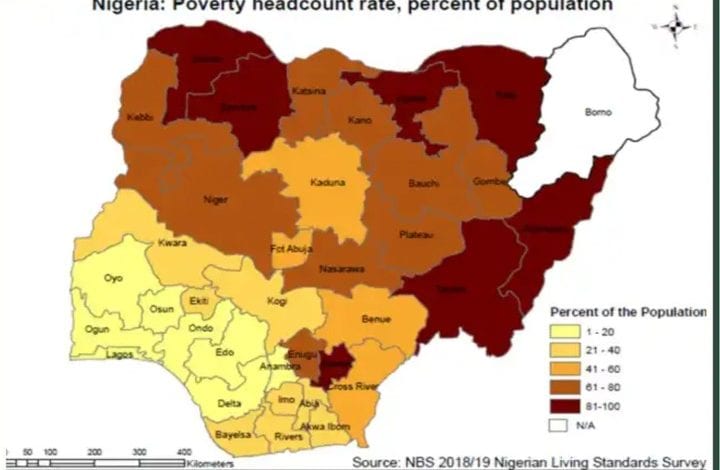
The truth and sad reality is that majority of our citizens are going to bed every night on hungry stomachs; poverty struts the land like a ferocious lion. The time to stop the menace is now. Given the right policies, iron-will determination, prudence and economic sagacity, it is a realisable goal.