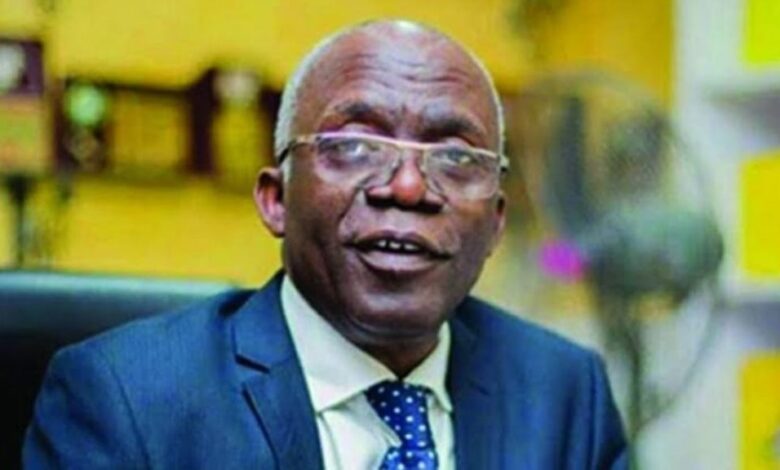
As the National Assembly advances constitutional amendments to establish a state police, renowned human rights lawyer and Senior Advocate of Nigeria (SAN), Femi Falana, has cautioned that decentralising Nigeria’s policing system without strong accountability mechanisms could create more problems than it solves. Drawing lessons from the First Republic, Falana argues that the real challenge lies not in creating another police structure but in ensuring effective oversight, sustainable funding and institutional safeguards. He spoke on Channels Television’s Politics Today. David Lawani monitored the interview
President Bola Tinubu has transmitted an Executive Bill seeking a Sixth Alteration to the Constitution to pave the way for state police. What was your immediate reaction when you saw the proposal?
My mind immediately went back to the First Republic because there is really nothing novel about what is being proposed. Between 1960 and 1966, Nigeria operated a decentralised policing system. We had the Federal Police on the one hand and regional and local government police on the other. In the North and the West, where policing structures were more developed, police officers were popularly known as Yandoka in the North and Olopa in the West. So, historically, Nigeria has operated this system before. However, we must honestly ask ourselves why the country abandoned that arrangement. It was largely because of the widespread abuse of police powers by regional political leaders. That unfortunate experience generated intense national debate between 1975 and 1979. At the end of those deliberations, political leaders, constitutional experts and other stakeholders collectively agreed that Nigeria required a centralised police system. That consensus eventually gave birth to the Federal Police Force under the 1979 Constitution. If we are now contemplating a return to the old order, we must ask whether the problems that led to the abolition of regional police have truly been addressed. Unfortunately, I have not seen any convincing evidence that they have. I have studied the bill passed by both chambers of the National Assembly, and frankly, I find it rather sketchy. Beyond providing that governors will appoint Commissioners of Police, the legislation says very little about the critical issues. How exactly will those appointments be made? What institutional safeguards will prevent abuse? What checks and balances will ensure that appointments reflect the interests of the people rather than the wishes of those in power? Equally important is the issue of funding. How do we expect states that are already struggling to pay salaries and pensions to finance, equip and maintain an effective police service? These are not minor concerns. They are fundamental legal, political, administrative and financial questions that remain unanswered. While everyone agrees that Nigeria faces serious security challenges, creating another police structure without addressing these issues could merely reproduce old problems in a different form.
Many Nigerians believe the worsening insecurity, especially kidnapping and violent crime, makes the creation of state police inevitable. Beyond passing the bill, what should happen next to ensure the reform succeeds?
The legislative process has certainly moved forward. The President transmitted the bill to the National Assembly, and both chambers have already passed it. However, the process is far from complete. The Constitution requires that at least two-thirds of the State Houses of Assembly—that is, no fewer than 24 states—must approve the amendment before it can become law. But constitutional approval alone will not resolve the real issues. We must now sit down as a nation and determine how Commissioners of Police will be appointed to ensure professionalism, independence and accountability. The fundamental question is this: are we merely domesticating the existing Federal Police structure at the state level, or are we genuinely creating a people-oriented police service that serves the public rather than political office holders? Those are the issues that deserve far greater attention than the mere passage of the bill.
Some critics argue that the renewed push for state police, coming this close to another election cycle, raises political suspicion. Given the level of distrust in the political system, do you think those concerns are justified?
I do not think we should criminalise politicians simply because elections are approaching, and I am not one to indulge in conspiracy theories. The debate over restructuring and state police did not begin today. It has been part of the national conversation for many years, particularly since the restructuring campaign gained momentum nationwide. Whether the state police are established today or after the next election, the unresolved questions remain the same. That is why some people speculate that the proposal forms part of preparations for the 2027 elections. But speculation aside, if we fail to resolve the structural problems surrounding accountability, funding and operational independence, creating another police organisation will not solve Nigeria’s security crisis. The solution does not lie merely in increasing the number of police officers or establishing more police stations. What Nigeria urgently needs is a properly equipped police service, continuous professional training, modern surveillance infrastructure and advanced technology capable of detecting, monitoring and tracking criminal activities. We are no longer dealing only with conventional criminals. Terrorists, kidnappers, cybercriminals and organised criminal networks now deploy technologies that, in many instances, are far more sophisticated than those available to our security agencies. While some law enforcement agencies still depend largely on conventional communication systems, criminal organisations have continued to evolve technologically. If we truly intend to secure this country, we must invest seriously in intelligence gathering, modern equipment, personnel welfare and continuous capacity building. Without those investments, the creation of state police alone will not produce the security outcomes Nigerians expect.
The proposed legislation empowers governors to appoint Commissioners of Police, issue policing directives and operate alongside the Federal Police, while also providing safeguards against political interference. Which aspect of the bill concerns you the most?
My greatest concern is that there is no consensus even among the governors themselves on the desirability of state police. Some governors have openly admitted that they lack the financial capacity to establish and sustain such a police service. The strongest argument against state police has always been the possibility of political abuse. That fear has not disappeared. We have witnessed situations where governors deployed political thugs against opponents, and there have also been occasions when the Federal Police had to intervene because of abuses at the state level. For that reason, I believe the National Assembly ought to have subjected this proposal to far more extensive public consultation before passing the bill. Now that it has gone to the State Houses of Assembly, the people at the grassroots must be allowed to interrogate its provisions and make meaningful contributions. Another mistake we often make is reducing insecurity to the absence of police stations and police officers alone. That approach overlooks the root causes of crime. Why are increasing numbers of young Nigerians embracing criminality? Why are jobs not being created? Why are millions of citizens trapped in extreme poverty without meaningful social support? Unless we address these underlying socio-economic realities, creating state police—or even local government police—will not, by itself, solve the country’s security challenges. We also need to examine the existing institutions. The Nigerian Police Council, which comprises the President, the 36 state governors, the Inspector-General of Police and the Police Service Commission, is constitutionally empowered to supervise the Nigeria Police Force. Yet, that council hardly meets. Since 1999, policing has, in practical terms, been directed almost exclusively from the Presidency, even though the Constitution envisages a shared oversight mechanism. Therefore, the concerns expressed by Nigerians should not simply be dismissed. In reality, many states already operate one form of security outfit or another. In Borno, there is the Civilian Joint Task Force (Civilian JTF). Lagos has the Neighbourhood Safety Corps. The South-West operates Amotekun, while Kano has the Hisbah Corps. So, when people advocate for state police, they are, in many respects, calling for the formal recognition and strengthening of existing structures. The real problem is that these organisations are neither adequately funded nor sufficiently empowered to discharge broader policing responsibilities. The questions we should therefore be asking are straightforward: How will these institutions be financed? What accountability mechanisms will regulate their operations? How do we prevent violations of fundamental human rights? Those are the issues that should dominate this national conversation.
Some security experts argue that Nigeria’s major challenge is not merely the shortage of police personnel but weak intelligence gathering and slow operational response. Given that reality, are you satisfied with the existing centralised policing system?
There is no doubt that Nigeria is grossly under-policed. We do not have enough police officers to effectively police a country of this size and population. However, the issue goes far beyond numbers. Modern policing is driven principally by intelligence gathering, timely response and institutional accountability. Without those elements, merely increasing the number of officers or creating additional police formations will not automatically improve public safety. Every institution that exercises coercive powers over citizens must itself be subjected to strict accountability. Therefore, if Nigeria is determined to establish state police, then the Federal Police must also undergo comprehensive reform. Appointments to both institutions should not depend solely on the discretion of either the President or state governors. There must be transparent appointment procedures, independent oversight bodies and clearly defined checks and balances capable of preventing abuse of power. Only then can we build policing institutions that truly serve the people rather than those who control political power.
Lagos State Governor Babajide Sanwo-Olu believes state police could become a decisive weapon against kidnapping and other violent crimes. Do you share that optimism?
I have tremendous respect for Governor Babajide Sanwo-Olu and appreciate his position. However, we must confront the practical realities. Can we honestly say that every governor—including those who currently struggle to pay workers’ salaries—will suddenly find the enormous financial resources required to recruit, train, equip and sustain a functional state police service? That is a legitimate concern. Perhaps a more practical option would be for neighbouring states facing similar security challenges to establish regional police services rather than each state creating an entirely separate policing bureaucracy. The debate has now begun, and that is a positive development. But the government owes Nigerians clear answers to several practical questions. How exactly will state police be financed? How will officers be recruited and professionally trained? How will state police services collaborate with the Federal Police? What mechanisms will govern intelligence sharing, operational coordination and jurisdictional conflicts? Unless these practical issues are comprehensively resolved, we risk repeating the very mistakes that led to the collapse of the decentralised policing system during the First Republic.