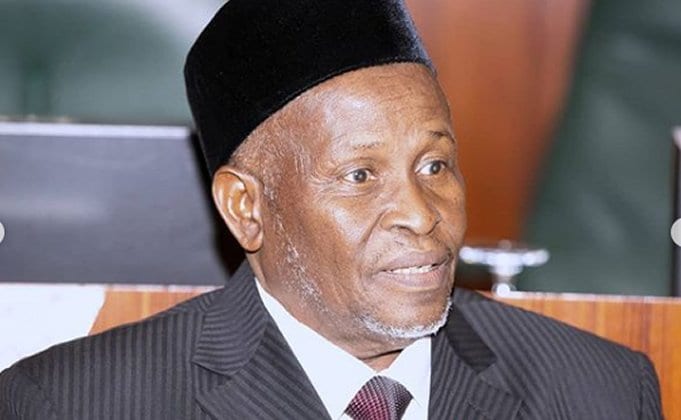
Nigerians were held awe-bound last week as the Chief Justice of Nigeria (CJN), suddenly threw in the towel, citing health reasons. In this piece, DEBORAH ONYOFUFEKE reviews the emergence and stewardship of Justice Tanko Mohammad as Nigeria’s 16th apex court judge
Nobody would believe that a sitting president of Nigeria possesses the constitutional powers to suspend or remove a Chief Justice of Nigeria (CJN), the head of the judiciary arm of government, from office, and within days, as was done on January 25, 2019, when President Mohammadu suspended Justice Walter Onnoghen as the CJN.
Yes, it happened, and to the surprise of many. Buhari did this following a controversial ex parte order issued by the chairperson of the Code of Conduct Tribunal (CCT), Danladi Umar, on January 23, 2019, over charges of failure and non-declaration of assets earlier filed against Onnoghen by the Federal Government, through the Code of Conduct Bureau (CCB).
Onnoghen’s travels began in 2019 after a civil rights group filed a petition against him at the CCB.
Among the allegations levelled against him was owning some secret foreign accounts, which were run in a manner inconsistent with financial transparency and the code of conduct for public officials.
Although he denied the allegations, Onnoghen was convicted by the CCT on April 18, 2019, for false assets declaration, and banned from holding public office for 10 years.
The procedure adopted in the then CJN’s case was faulted by some notable lawyers who queried why he had to be taken before the CCT, instead of the National Judicial Council (NJC).
Onnoghen insisted that he had done no wrong. Many Senior Advocates of Nigeria (SAN) and others observed at the time that, while Onnoghen might have erred, his removal was more about the 2019 election, and the attempt by the ruling party to seize control of the post-election process.
Husband sets wife ablaze in Ogun State
He alluded to this two years after when the ex-CJN said he was relieved of his position by the Buhari administration over perceived feelings that he had a secret meeting with the then presidential candidate of opposition Peoples Democratic Party (PDP), Atiku Abubakar, in Dubai, before the 2019 general elections.
The president’s action considered an aberration by some persons, culminated in the compulsory retirement of Justice Onnoghen and subsequent swearing-in of Justice Tanko Mohammad, considered next to him in seniority, as the successor, first on January 24, 2019, in an acting capacity, and a substantive capacity as the CJN on July 24, 2019, six months after.
Onnoghen had been left with almost two years before he was scheduled to retire in December 2020.
A few days after, his reign as the nation’s topmost judiciary officer, Justice Tanko Muhammad, who was said to have spent some years earlier as a Sharia Court judge, faced allegations of age falsification by a 46-year-old businessman, Tochi Michael.
Michael had claimed that the judge altered his date of birth by three years from December 31, 1950, to December 31, 1953. Muhammad denied the allegations, and a federal judge later ruled on May 31 that the complainant had no right to file the lawsuit.
The court also said there was no evidence to back the claim against him and scolded the complaint, said to be an Abuja-based lawyer, as filing the case to deface Justice Muhammad’s public image as an honourable man. A N10m fine was also imposed on the lawyer for instituting a frivolous case in contravention of extant rules of the judiciary.
Many other petitions were brought against the CJN by individuals and organisations, but none of them succeeded.
The appointment of Muhammad elicited negative reactions with many, including senior advocates of Nigeria, speaking against his confirmation as substantive CJN.
For instance, a Senior Advocate of Nigeria (SAN), Olisa Agbakoba, had demanded the removal of Muhammad as the acting CJN over alleged misconduct.
“Justice Tanko Mohammed is fully aware of the state of law, yet presented himself to be sworn in by the president,” Agbakoba wrote in a petition to the NJC.
“Incidentally, Justice Tanko Mohammed was a member of the NJC panel that removed Justice Obisike Orji of the Abia State High Court for accepting to be sworn in as Chief Judge by the Governor of Abia State, without the recommendation of the NJC.
“It is a matter of regret that Justice Tanko Mohammed who participated in this process will lend himself to this constitutional infraction,” Agbakoba said.
The emergence of the 68-year-old jurist, Muhammad, was greeted with mixed reactions, given that the development came just some months ahead of national elections.
While faithful of the nation’s ruling party, the All Progressives Congress (APC), saw nothing wrong with jubilation over Buhari’s action, members of opposition political parties in the country kicked against it, accusing the government of President Buhari of bringing Justice Tanko to play “dirty game” in the post-election litigations being expected.
Like they had feared, Justice Mohammed did not disappoint them as a few months after being on the saddle, he presided over the most controversial election judgment ever witnessed in the country.
On January 14, 2020, the Supreme Court voided the election of Emeka Ihedioha as the governor of Imo State. A seven-man panel of the apex court led by the Chief Justice of Nigeria, Tanko Muhammad, unanimously declared Hope Uzodinma as the winner of the March 9, 2019, governorship election, and the validly-elected governor of the state.
This was after Hope Uzodinma, who had lost his case at both the election petition tribunal and the appeal court to Ihedioha, approached the apex court on appeal. He argued that Ihedioha did not score the highest number of votes in the governorship election — because results from 388 units were excluded from collation by INEC.
The panel led by the CJN agreed with the appellant’s argument and affirmed Uzodinma (who came fourth in the election) as the duly-elected governor of Imo State. However, Chima Nweze, one of the judges, disagreed with the ruling.
In his dissenting judgement, Nweze asked the court to set aside the January 14 judgment that removed Ihedioha from office, describing it as a nullity, and in bad faith.
Another controversial judgment of the Supreme Court under CJN Tanko was on June 17 when the apex court approved the use of hijab by female Muslim students in Lagos State Government-owned schools.
Religious organisations, including traditionalists, had flayed the decision of the Justice Tanko Muhammad-led court, alleging undue preference for a particular religion in a country considered to be secular.
A human rights lawyer, Malcolm Omirhobo, showed up at the Supreme Court last Thursday, June 23, 2022, to protest against the judgment of the court sanctioning the use of hijab by female Muslim students in Lagos State public schools.
Husband sets wife ablaze in Ogun State
Omirhobo, claiming to be expressing gratitude and solidarity over the ruling, abandoned his regulation’s dress code as a lawyer and showed up as an “Olokun” priest in court.
He has since continued to show up in court in the same attire while urging everyone to emulate his example and go to work in their religious garments.
Under Justice Tanko Muhammad’s watch, there were frequent cases of indiscipline on the Bench, which the NJC struggled to address without success. Judges and lawyers openly abused court processes, with courts of equal jurisdiction violating elementary rules of procedure. Ex parte orders became so common.
The nation woke up on June 21, 2022, to realise that Justice Tanko, who was always having his way in any apex court’s decision, was equally facing a silent revolt over his style of leadership by his fellow justices who accused him of corruption, a development seen as a major blow to the integrity of the judiciary under him.
In a protest memo signed by 14 Supreme Court judges, Muhammad was accused of not giving justices their legitimate entitlements. The justices said their annual foreign training, meant to enhance capacity building for the country’s judicial process, had been blocked by Muhammad.
The main issues put forward by the justices in their letter through a welfare committee were; non-replacement of poor vehicles; accommodation problems; lack of drugs at the Supreme Court clinic; epileptic electricity supply to the Supreme Court; increase in electricity tariff; no increase in the allowances for diesel; lack of internet services to residences and chambers.
“Your lordship has received and ignored these demands since 24th March 2022.
“In the past, justices were nominated to attend two to three foreign workshops or training per annum with accompanying persons for reasons of age. Since your Lordship’s assumption of office, Justices have only attended two workshops in Dubai and Zanzibar.
“They were not accorded the privilege of travelling with accompanying persons, as was the practice.
“Your Lordship ignored this demand and yet travelled with your spouse, children, and personal staff. We demand to know what has become our training funds, have they been diverted, or it’s a plain denial?
“Your lordship may also remember that the National Assembly has increased the budgetary allocation of the Judiciary. We find it strange that, despite the upward review of our budgetary allocation, the court cannot cater to our legitimate entitlements. This is unacceptable,” they said in the memo cited by ThisNigeria in Abuja.
The justices had threatened to stop sitting by September if Muhammad was not removed as CJN.
In his defence, Justice Tanko Mohammad, through his spokesperson, Ahuraka Yusuf Isah, said the Supreme Court is “affected by the economic and socio-political climate prevailing in the country.”
Isah further stated, “The judiciary, the third arm of government under the doctrine of the separation of powers, has never been more divided. The import of the letter by the 14 justices was that they had lost confidence in the leadership of Justice Tanko Muhammed.”
And so on Monday, June 27, 2022, Justice Tanko Mohammed threw in the towel, citing unfavorable ill-health as the reason for his action.
The events leading to his sudden resignation, no doubt, question the authenticity of his claim of resignation on health grounds.
To this effect, President Buhari immediately administered an oath on Justice Olukayode Ariwoola, considered the most senior to him as the new acting CJN, to take over from him.
Indeed, before he threw in the towel, the Nigerian Bar Association (NBA), through its president, Olumide Akpata, waded into the matter, concluding that “there is a clear need for mechanisms to be put in place to ensure that the judiciary is providing the necessary template to other arms of government on transparent procurement and budgeting.”
N1.8bn: Recall Buratai for investigation, PDP urges Buhari
“This will reduce the perception in some quarters that the judiciary is not accountable to anyone and is also not self-regulating”, the body said.
Also, as a follow-up to this, a human rights lawyer and activist, Malcolm E. Omirhobo, through his law firm, Malcolm Omirhobo, and Co, wrote a Freedom of Information (FOI) request letter to the former CJN, asking for details of transactions of the Supreme Court from 2019 till date.
The FOI Request letter demanded: (1) “proof of receipt of total funds disbursed to your Lordship from the National Judicial Council as head of the Supreme Court of Nigeria; (2) The Financial Statement of Accounts of the Supreme Court of Nigeria from the 1st day of January 2019 to date; (3) Proof of the total expenditure of the Supreme Court for the period of 1st January 2019 to date… (4) Payment vouchers for projects; (5) The total amount realised from Internally Generated Revenue.”