By Francis Ajuonuma and Cross Udo
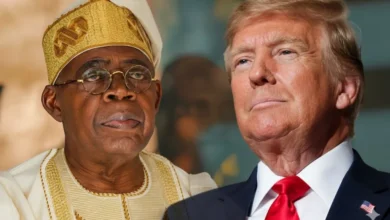
United States President Donald Trump has issued a warning to countries aligning with BRICS, threatening to impose a 10% tariff on their exports to the United States, a move that could further destabilise Nigeria’s economy.
Trump’s threat, posted on his Truth Social platform, declared, “Any country aligning themselves with the Anti-American policies of BRICS will be charged an ADDITIONAL 10% Tariff. There will be no exceptions to this policy.”
The timing of the statement is highly explosive politically. President Bola Tinubu had just arrived in Brazil to attend the 17th BRICS Summit in Rio de Janeiro — Nigeria’s first appearance as an official BRICS “partner country” following its admission in January 2025.
Baring the impact this will have on its economy, the Nigerian government had pointed out that the US tariffs would hurt its oil and non-oil export businesses.
The ICIR reported that Minister of Industry, Trade, and Investment Jumoke Oduwole stated that the measure could potentially disrupt trade relations and impact the competitiveness of Nigerian products in the US market, particularly in sectors reliant on market access and price competitiveness.
She noted that a significant portion of over 90 per cent of Nigeria’s exports, comprising crude petroleum, mineral fuels, oils, and gas products, would be affected.
While the BRICS partnership was intended to herald a new era of South-South cooperation and economic diversification, Trump’s retaliatory rhetoric threatens to undermine those gains, potentially drawing Nigeria into a perilous economic crossfire.
Nigeria, already battered by inflation (which peaked at 34.2% in mid-2024 before a modest decline), currency devaluation, and heavy reliance on oil exports, stands vulnerable.
An additional 10% US tariff on BRICS-aligned countries could deal a significant blow to Nigeria’s trade prospects, particularly with the US, a top importer of Nigerian crude oil and petroleum products.
Over 90% of Nigerian exports to the US are oil-based.
The ripple effect on the country’s narrowing revenue base, already strained by the removal of fuel subsidies and forex reforms, could be severe.
*Tinubu’s global pitch meets a global pushback
Ironically, while Trump was threatening tariffs, President Tinubu was mounting a passionate case for a more inclusive and equitable global system. In his address at the BRICS Summit, Tinubu pushed for structural reforms in international finance, healthcare, and climate policy.
“Africa has contributed the least to global emissions but suffers the most,” Tinubu told fellow BRICS leaders, arguing for a new global compact anchored in justice, fairness, and sustainable development.
He highlighted Nigeria’s Vision 2050, its involvement in climate initiatives, and the urgent need for global cooperation on debt relief, non-communicable diseases, and access to technology.
However, critics argue that Tinubu’s lofty ambitions may soon clash with harsh geopolitical realities. “If Nigeria becomes a casualty of another Trump trade war, the BRICS partnership might start to feel more like a liability than an opportunity,” one international trade expert noted.
The crux of Nigeria’s dilemma lies in its strategic tightrope walk between aligning with BRICS and maintaining its long-standing trade ties with the West.
The partner status with BRICS, just a step below full membership, gives Nigeria a voice at the table but not necessarily protection from the backlash of global power plays.
And Trump’s direct threat makes clear that association alone may be enough to trigger penalties.
Tinubu’s decision to join BRICS is rooted in a desire for economic sovereignty and multilateral alliances that extend beyond the traditional Western orbit. However, that move could now have serious trade-offs, especially if Trump regains office in 2025 and fulfils his threats.