By Mudiaga Affe, Emma Obe, Ben Ogbemudia, Kassim Omomia, Cajetan Nmuta and Andy Asemota
In their voices, pessimism holds the aces. On their faces, what is boldly written is gloom. In their informed commentaries, the discerning undercurrent is that the 61-year-old nation is sitting on a time bomb. And, of course, in their emphatic verdict: all is not well with the nation’s economy.
These are the observations and unanimous views of economists and experts as they appraise the state of the nation’s economy, particularly the recent National Bureau of Statistics’ disclosure that the percentage of unemployment rate in the country has hit the rooftop.
So, are there unresolved issues with the economy? The experts’ response is in the affirmative. Is there a connection between the economy and the progressively social consequences in the country? Again, their response is in positive.
According to them, one cannot truly divorce the increasing cases of banditry, kidnapping, terrorism, among other vices, in the country from the parlous economy.
Among eminent Nigerians, who hold these views are the a professor of Economics at the Olabisi Onabanjo University, Ago-Iwoye, Ogun State, Sherrifdeen Tella; Former Head, Department of Economics, National Open University of Nigeria (NOUN), Abuja, Prof. Ganyat Adesina-Uthman; a professor of Political Science, Femi Otubanjo;Chairman of the Rivers/Bayelsa States Branch of the Manufacturers Association of Nigeria (MAN), Senator Adawari Michael Pepple.
Other analysts are the Executive Director, Africa Network Environment and Economic Justice (ANEEJ), David Ugolor; Director of Legislative Support Services, National Institute for Legislative and Democratic Studies, National Assembly Abuja, Prof. Edoba Omoregie; and the Head of Department, Business Administration, University of Abuja, Dr. Nana Bature.
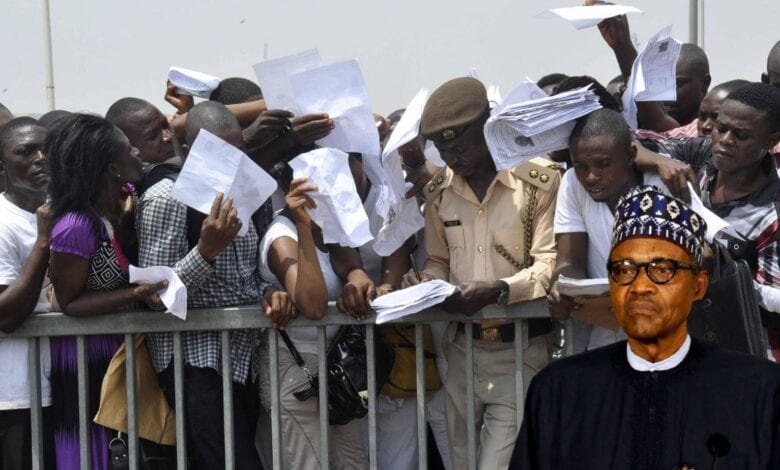
The NBS had revealed on March 15 that unemployment rate in the country rose to 33.3 per cent in three months through December, up from 27.1 per cent in the second quarter of 2020.
This latest figure indicated that unemployment in Nigeria, which is Africa’s largest economy, surged to the second-highest on a global list of countries.
For Tella, the federal government’s policy of hiking the price of petroleum products, electricity tariffs, taxes, and other levies at a time when other economies are encouraging production is not good for Nigeria.
According to him, the country is sitting on a time bomb, especially if nothing is urgently done to change the narrative.
The renowned economist said, “All along, unemployment has been on the rise, inflation has been increasing while the economy has been shrinking but the government seems to be lying about it. The problem is getting worse because the government seems not to be getting it right with the production and consumption relationship.
“From the agricultural and manufacturing sectors, the cost of production is on the increase. This is the outcome of the continuous increase in the price of petroleum products. When you begin to say there is subsidy today and no subsidy tomorrow, it means that the government’s policy is unpredictable and this will make producers unpredictable in their decision making too.”
Tella noted that the agriculture and manufacturing sectors which have large labour forces were shrinking due to insecurity.
“When you increase electricity tariffs and other taxes, it will naturally make the cost of production increase because producers cannot sell below cost price. In addition to this, there is a high level of insecurity and many farmers are afraid of going to the farm even when the rain has just started. So, soon, we would be in serious trouble in terms of food.
“It seems that the government does not care much about the fact that insecurity is affecting agriculture. The herdsmen will do their own and the bandits too. Nobody is going to invest and allow his crops to be destroyed. The farmers are disenchanted.
“Recall that both agriculture and manufacturing employ good numbers of labour and if there is a downturn in their production you will surely have a continuous increase in unemployment. It simply means that the idle mind is the devils’ workshop and that is why there is an increase in crime rate which is not good for the economy.”
Governments in other climes, the academic added, were encouraging consumption by assisting those without jobs.
Tella declared, “But in Nigeria, instead of giving out money, our government is busy increasing the cost of living by asking them to pay more for fuel, electricity, and taxes. Apart from intervention, some other countries are subsidising so many things but our government is blind to all these. That is what is leading to increasing unemployment. We are sitting on a time bomb and something needs to be done urgently. The government should encourage the production and consumption sectors”.
X-raying the situation, Otubanjo said having a whopping 33.3 per cent of joblessness, comprising mostly youths will lead to restiveness and agitations with its attendant increase in crime rates.
The implication, according to the professor of Political Science, is that about 66 million Nigerians are unemployed.
Otubanjo noted, “It is an unfortunate and dangerous development, particularly if the over 33 per cent of unemployed persons is made up of young people. It means that we have an army of restive, agitated young people which is a time bomb we have with unemployment. I will be surprised if the figures are not higher than that.
“Going by our population of 200 million people, it means about 66 million people are unemployed and that is incredible. If we remove the percentage of students and young people who are still in the nursery, primary and secondary school, it means that only less than 30 per cent of Nigerians are working.
“We would not be surprised if that is what has translated to all these banditry, terrorism, kidnapping, armed robbery, and other crimes. It means that we are fertilising crime on a massive scale. There is no social fall back for anybody in Nigeria for those who are unemployed or sick to get little support.”
He blamed the politicians for the rise, calling on all the leaders of the country to put on their thinking cap to address the looming time bomb.
“The politicians are busy taking all the money to fend for themselves and their comfort. Our leaders will need to address these challenges at this point. What else can happen to a country? We are going down. We would have to stop that catastrophic fall that we are facing now. It is a pity because we are facing it on all fronts,” Otubanjo added.
Contributing, Adesina-Uthman, said the NBS figure was alarming for a country battling various forms of insecurity, youth restiveness, poverty and inflation.
The Economics teacher said, “The time bomb is trying to explode because you can see the rate kidnappings have increased at an alarming rate not only in the North but also in the South. The Fulani are not the only people perpetuating this evil. The Yoruba, Igbo, and Hausa are also involved. This shows that the poor standard of living cuts across all tribes in the country”.
Adesina-Uthman, who described the soaring unemployment rate as inevitable in the face of COVID-19 and fall in petroleum price in the global market, stressed that the nation could have reduced the rate better through the provision of infrastructure and restructuring so that people and different tiers of government could think out of the box by investing in job creation.
For the Anambra State Nigeria Labour Congress (NLC), Chairman, Jerome Nnubia, the alarming rate of unemployment is the major cause of insecurity in the land.
He said, “The alarmingly rate of unemployment as reported by the NBS is one of the major causes of increased robbery, kidnapping, abduction and youth restiveness in Nigeria”.
In the thinking of the Chairman, Rivers/Bayelsa states branch of the Manufacturers Association of Nigeria (MAN), Senator Michael Pepple, the frightening unemployment and inflation data as conveyed by the NBS would worsen if the government failed to tackle corruption in the customs as well as support agriculture and manufacturing.
According to Pepple, agriculture and manufacturing hold the key to reducing the high incidence of unemployment and inflation. But sadly, he added, the sectors have not been receiving deserving incentives from the government.
He alleged that even when manufacturers and investors survive the harsh production climate in the country, Customs officials at the ports, who demand huge bribes to allow for exports, frustrate their efforts.
The MAN chairman said that while other African countries were mapping out strategies and blocking corruption loopholes, Nigeria is just pretending about it. “We are pretending as if it doesn’t matter, it is business as usual.”
Pepple added, “These sectors have to be addressed before the issue of unemployment can be tackled. And two of them go together. When the farmer produces, he passes it on to the manufacturer who processes the other products and there is a value chain all along the way. But here we are ignoring agriculture and manufacturing.
“Why won’t there be a high level of unemployment? Rather than recruit people, businesses, manufacturing businesses are laying off workers because they cannot balance their accounts with the number of workers they have. No support from the government.”
Unemployment data fearful–PDP chair
National Chairman of the major opposition party (PDP), Prince Uche Secondus, described the unemployment situation in the country as “fearful data.”
Secondus said, “By the time you minus the minors and the aged in the nation, you will discover that virtually all youth population are unemployed. It’s a fact. Remove the children, remove the aged, you will see that virtually all the youth are unemployed. The country is in problem.”
Speaking during the presentation of the party’s 2019 elections review committee’s report in Abuja, he lamented, “It is not difficult to see why the nation is being overwhelmed by insecurity, kidnappings, and all whatnot. Our youth population has been ignored, that is the truth.”
Also, the Chairman of the Civil Liberty Organisation, (CLO), South-East zone, Aloysius Attah, said the future of the country was bleak.
He blamed the nation’s leaders, especially the Presidency for the woes and pains the citizenry encounter in the country.
Attah said, “The future for Nigeria is very bleak. This is an uncertain time in Nigeria because when you have leadership that is ineffectual and doesn’t care about the welfare of the citizenry which is the primary purpose of government, this is the kind of thing you see.
“Unfortunately, the widening gap between the haves and have nots is getting worse that the masses are so disoriented, weak to be protected and to hold the leaders accountable. That is the tragedy of a country which we are facing presently.”
Consequences
An accountant with a private firm in Abuja, Dr. Usman Abdullahi, said the unemployment rate has provided a ready pool for non-state actors to feed into.
One of the consequences of the threat, according to him, is that Foreign Direct Investment (FDI) will reduce and prospective investors will become reluctant to invest in Nigeria, further worsening poverty and unemployment, creating a vicious circle.
He added that the trend could lead to complete deterioration of security and collapse of the state.
Abdullahi, however, said the government could create long-lasting solutions to these problems by tackling the structural challenges that affect the growth and development of Small and Medium Enterprise (SMEs) to boost employment.
According to the Executive Director, Africa Network Environment and Economic Justice (ANEEJ), Rev. David Ugolor, there will be a rise in insecurity because more people will become desperate to survive.
Ugolor, the ANEEJ boss noted, “The insecurity rate now is exponential, there are more cases of mass abductions in the country because it has become lucrative. Government must, therefore, provide the enabling environment for employment”.
Way forward
For renowned political economist and founder, Centre for Value Leadership, Prof. Pat Utomi, insecurity, poor investment climate and indiscipline are some of the challenges fuelling unemployment in the country.
To alter the complexion of the crisis, Utomi urged the country’s leaders to show political maturity as well as to evolve a national strategy for growth and development.
He explained, “There are several ways out. Some of them require political maturity and leadership. For example, there is no way you wont have a declined economic activity if everywhere is insecure. People for fear of their lives are not going to farms, for example, so agricultural output will fall. People who are going to make investments, they look at the atmosphere, they would hold back on investments. If you don’t make investments, there won’t be production, there won’t be growth.
“Then more immediately, and importantly, we need a strategy, we need a national strategy for growth and development, we don’t have one. We have the one that Vice President Yemi Osinbanjo was presiding over, the Economic Sustainability Committee (ESC).
But you see that is a technical kind of thing, it is not a grand strategy, but it is good. It is useful. But we have got to have a grand strategy. What is the general thrust of Nigeria’s grand strategy? It is not clear to me, at least, and I am sure it would not be to many more people. I have always advocated that Nigeria should adopt a strategy rooted in what structure Economists would call latent Comparative Advantage, where you take your factor endowments”.
The UNIABUJA lecturer, Bature, noted that the rising unemployment rate in the country bordered on corruption which must be quickly eradicated to eliminate unemployment.
Bature said there should be a proper employment succession plan to accommodate graduating and qualified youths in the country.
“It is a big problem if you don’t give youths jobs, especially those who merit it. If you allow them to be on the streets, it is a big problem for the country.
“Government is trying but needs to try harder by being sincere with a workable succession plan. Those who are done, those in the offices, who are due to leave should give way for youths to grow, to be employed so that we have a proper succession plan,” she added.
Bature’s counterpart at the Information and Communications Technology Department, Prof. Afolayan Obiniyi, decried the current education curriculum, saying that it breeds unemployable Nigerians.
The professor of Computer Science noted that the country’s rising unemployment rate, was because the nation currently breeds and passes out unemployable graduates since the school curriculum was not tailored towards industrialization.
“It is the right time now to groom, train Nigerians in skills, innovations from primary, through to secondary and tertiary school levels. This will enable them to create wealth, and make them employers of labour, instead of idling away and waiting for government jobs.
“It is only when the government begins to think along this line, that we can tackle the twin issues of unemployment and insecurity. I say this because those who are idle and jobless, fight the state in return for their insensitivity,” Obiniyi suggested.
The Director, Legislative Support Services, National Institute for Legislative and Democratic Studies, Abuja, Prof. Edoba Omoregie, urged the different tiers of government to reduce taxes, especially on small and medium-size businesses.
The initiative, Omoregie added, would help to stimulate employment in those sectors.
Toeing the same line, Prof. Agharese Osifo of the Department of Agric. Economics, Ambrose Alli University (AAU), Ekpoma, Edo State, frowned on the unemployment rate, saying that it is a recipe for socio-economic upheavals similar to the #EndSARS protests of last year.
“You were building a time bomb gradually and now it has exploded!” – Obong of Calabar
Osifo added, “The unemployment scenario shows that Nigeria is not utilising a critical factor of production: labour. The unemployed have only their human capital to offer to help with the development of the country. Employment opportunity for them is the only thing that would help them raise capital to buy land and invest in productive activities”.
Buhari trying his best- Masari
Meanwhile, Governor Aminu Masari of Katsina State has condemned the politicisation of the state of the economy by any individual or group.
Masari said, “No political party since the independence of Nigeria has brought positive social intervention programme as the All Progressives Congress-led government. I can say so from the social interventions that have gone into my state”.
The governor, who explained that the COVID-19 pandemic and the fall of petroleum prices in the global market were not a creation of the Nigerian government, added that the nation would have been brought to its knees if President Muhammadu Buhari had not initiated many strategic policies.
Similarly,for the Head of Department, Political Science and International Studies at UNIABUJA, Prof. Sadeeque Abbah, examined the issues from another perspective.
“First I have doubt about the authenticity of the statistics in terms of objectivity and value validity. Two, unemployment is today a global challenge even to the major economies of the world. No country is immune from it. Third, from which dimension is the NBS coming from? Is it from the teeming unemployable graduates? Or from the angle of lazy youths that see productivity as slavery? Is the NBS statistics a function of urban syndrome or just city wise game of numbers?
“I am sure the report will go under if exposed to scientific vagaries of validity and reliability, especially if measured from the point of view of Nigerians looking for their share of national cake, rather than gainful employment. From graduates unemployment, the figures are higher and this is understandable. But from productivity point of view of Nigerians living in the rural areas and undefined sectors of our economy, NBS got it wrong.”