By David Lawani, Abuja
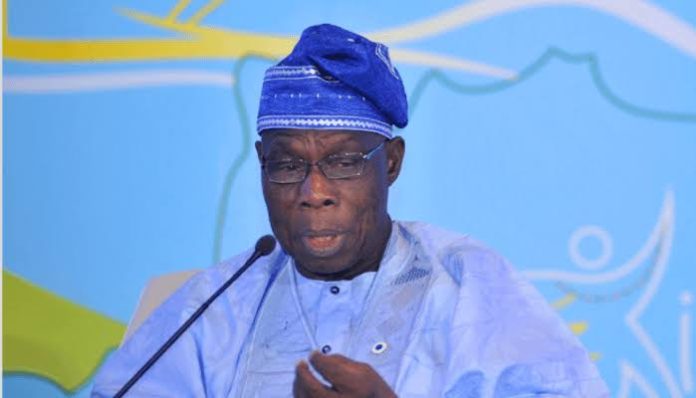
Former President Chief Olusegun Obasanjo has warned that Nigeria has yet to overcome the deep-rooted divisions that plunged the country into the 1967-1970 Civil War.
He cautioned that many of the factors responsible for the conflict remain unresolved more than five decades after the guns fell silent.
The former Head of State said Nigeria must confront those lingering fault lines with honesty and courage, insisting that the country cannot afford another civil war.
Obasanjo spoke in Abeokuta, Ogun State, during the presentation of Asaba Massacre, a historical account of one of the most controversial episodes of the Civil War, authored by the Isama-Aje of Asaba, Chief Chuck Nduka-Eze, at the Olusegun Obasanjo Presidential Library.
Delivering what appeared to be a solemn warning on the state of the nation, the former president said the conditions that ignited the Civil War have not disappeared.
“Some of the things that led to the Civil War are still on. Now, how long will this be with us?” Obasanjo asked.
He recalled a conversation with former Head of State, Gen Yakubu Gowon, who, he said, once warned that Nigeria might not survive another civil conflict.
“I was with a colleague when General Yakubu Gowon said, ‘We will not survive a second civil war as a country,’ and I believe that we have fought one civil war too many already.”
Obasanjo stressed that regardless of political or ethnic differences, Nigerians must unite to ensure that the mistakes of the past are never repeated.
“To say that we will have a second civil war—God forbid. We must do everything humanly possible to prevent its recurrence.”
The former president urged Nigerians to embrace history not to reopen old wounds, but to learn enduring lessons that can strengthen national unity and reconciliation.
“Thank you very much for making people know about it, for people to learn about it and for people to take a vow that never again. And I say to you, never. I will do everything possible to say never.”
Obasanjo said documenting difficult moments in the country’s history was essential for preserving collective memory and inspiring future generations.
“We pride ourselves on preserving the past, capturing the present, and inspiring the future. This is the past; we want to capture it, we want people to know about it,” he said.
Drawing from his own experience as a frontline commander during the Civil War, Obasanjo admitted that he could not provide a detailed account of the Asaba Massacre because military operations in the area were under the command of the late General Murtala Muhammed.
“When people talk about the Asaba Massacre, I always confess that I cannot give details of it,” he said.
He disclosed that although many people had approached him over the years seeking clarification on the role Murtala Muhammed played during the military operations in Asaba, he had consistently refrained from commenting on matters outside his direct command.
The former president, however, pledged to study the documentary evidence, transcripts and audio-visual materials compiled by the author before reaching any conclusions.
Obasanjo also recalled preventing acts of abuse against civilians during the war, including stopping a soldier from raping a woman in Asaba.
According to him, commanders had a responsibility to prevent atrocities committed by troops under their watch.
Earlier, the author of the book, Chief Chuck Nduka-Eze, said the publication was the product of extensive research based on eyewitness testimonies, archival records, recorded interviews, audio-visual evidence, and established historical scholarship.
He said independent sources consistently pointed to a disturbing sequence of events following the entry of federal troops into Asaba, then part of the Mid-West Region.
“The evidence establishes a recurring pattern. Civilians were assembled in public places under conditions of fear and uncertainty,” Nduka-Eze said.
According to him, residents were allegedly compelled to proclaim “One Nigeria” and publicly demonstrate loyalty to the Nigerian state before soldiers separated men from women and children.
“Compliance with these demands did not secure protection. Men were then separated from women and children. Thereafter, unarmed male civilians were killed in a manner consistently described across multiple independent accounts,” he stated.
Nduka-Eze said the findings were corroborated by documentary materials, eyewitness testimonies and scholarly works, adding that although exact casualty figures remain disputed, available evidence suggests that more than 1,000 unarmed civilians were killed.
He described the incident as a profound tragedy that shattered the social fabric of the Asaba community and continues to resonate decades later.
Like Obasanjo, the author warned that many of the grievances and divisions that fuelled the Civil War remain evident in contemporary Nigeria.
He said ethnic suspicion, distrust among communities and unresolved national questions continue to threaten the country’s cohesion.
The presentation of the historical work comes amid renewed national conversations on unity, restructuring and reconciliation, with Obasanjo insisting that confronting Nigeria’s painful past is essential to safeguarding its future.