By Ismail Abdulaziz
At the inception of President Bola Tinubu’s administration, the pesky fuel subsidy regime was ended to address the enormous infrastructure development gap created by the use of funds to power the subsidy.
Nigeria’s infrastructure deficit, amounting to 30 per cent of the nation’s Gross Domestic Product, falls short of the international benchmark of 70 per cent set by the World Bank.
According to Mele Kyari, head of the Nigerian National Petroleum Company Limited (NNPCL), Nigeria spent more than N400bn monthly to subsidise petroleum imports before President Tinubu’s inauguration.
These funds would, otherwise, be used to check infrastructure decay and shortfall in the country.
“The fuel subsidy is gone. The subsidy can no longer justify its ever-increasing costs due to drying resources. Instead, we shall re-channel the funds into better investments in public infrastructure, education, health care, and jobs that will materially improve the lives of millions.
“This is one decision we must bear to save our country from going under and take our resources away from the stranglehold of a few unpatriotic elements,” Tinubu said in his inaugural speech on May 29, 2023.
Nigerians were left with the choice of finding alternatives to subsidy funding, a choice recognised by the leading Presidential candidates of the Peoples Democratic Party and the Labour Party in the 2023 general election.
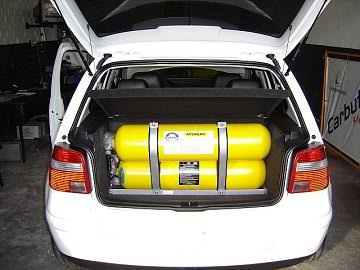
The Tinubu administration’s choice was to use Compressed Natural Gas (CNG) in vehicles, especially commercial vehicles, which constitute over 80 percent of petrol users in the country.
At the recent inauguration of 30 hybrid CNG-powered buses with the capacity to transport 3,000 passengers, Tinubu said the use of natural gas to power the nation’s transportation industry would reduce transportation costs.
He said it would also enhance productivity and save the nation trillions of naira spent importing petrol (motor spirit) and Automotive Gas Oil (AGO).
“If we can enhance our energy competitiveness and bring about transformative changes like this, we will be able to achieve the prosperity that we are working hard to accomplish for our people.
“These CNG buses are promising and will enhance our transportation system before the inauguration of President Tinubu.
“Countries like India have mandated CNG for all commercial vehicles since 2004. In Nigeria, commercial vehicles make up about 80 percent of our petroleum demand, costing us trillions of naira every month.
” The solution is here. We have it. We will work on it. We promise you things will get better. Prosperity will be achieved”, Tinubu said.
Energy experts say Nigerians need to take advantage of CNG-powered vehicles to ameliorate the huge financial implications occasioned by the high cost of petrol and its attendant increase in prices of goods and services.
“CNG is a necessary and feasible gaseous fuel that is relatively cheap, environmentally friendly, safe to handle, and has abundant available energy resources.
“By considering the availability and infrastructure facility, CNG seems to be a prominent alternative fuel for diesel engine applications,” says Ashok Nanthagopal in a study on Eco-Friendly Biofuels for CI Engine Applications published in Natural Gas (Second Edition).
According to him, earlier reports showed that CNG fuel could be considered well below conventional fuel in terms of performance.
Olalere Odusote, former commissioner for energy for the Lagos state government, said the CNG-powered vehicles are worth embracing.
The media recently quoted him as saying, “By embracing CNG, we can enhance energy security, create jobs, and propel Nigeria towards a brighter future for all its citizens.”
Experts say that CNG use is gaining acceptance worldwide because of its environmental and economic benefits. It is a clean-burning fuel that produces lower emissions than traditional gasoline or diesel, and it can also be less expensive.
Some known advantages of CNG use include lower emissions, energy savings, energy security, and longer engine life.
The disadvantages include limited range, limited fuelling infrastructure, high upfront costs, and safety concerns.
The concern of Nigerians centers on the disadvantages of CNG use and the availability of conversation services.
The government has responded to this concern through the Presidential CNG Initiative, established as a component of the administration’s palliative intervention to cushion the hardships of fuel subsidy removal and allay users’ fears.
Another energy expert, Mr Taiwo Adewole, said introducing CNG vehicles into Nigeria’s transport industry would help fight pollution.
“CNG-powered vehicles and generators will help fight pollution from fossil fuels that an average Nigerian uses daily. The government also needs to work on adequate power supply”, he told a local energy medium.
Air Vice-Marshal Akugbe Iyamu (retd), former Acting Director-General, National Emergency Management Agency.
“There is no way to turn back on delivering CNG for all Nigerians. It is the right thing to do,” Iyamu said.
Mele Kyari, the Group Chief Executive Office of Nigerian National Petroleum Company Limited, has also endorsed the CNG initiative.
“Is it late? Yes, but we will make progress, we will cover the gap in order to ensure that the volatility we see with motor spirit does not apply to gas,” said Kyari.
This is possible by making the conversion process accessible and assessable and continuing to encourage its use among both commercial and private car owners in the country.
However, those in the transport industry say the decision to use CNG for vehicles depends on individual needs and preferences, as well as the availability of refuelling infrastructure in the country.
(NAN Feature)