By Linus Aleke
The Nigerian Navy (NN), is statutorily tasked with the responsibility of maintaining the nation’s territorial integrity, through the maritime space. But, beyond the general task of maintaining territory integrity in Nigeria’s maritime environment, it is also, the duties of the Service to police the abundant mineral resources deposited in the womb of Nigeria’s waters.
Another humongous responsibility placed on the shoulders of the Service, is to ensure that Nigerian waterways is safe, as no fewer than 70 percent of international trade are transported through the maritime space.
Nevertheless, the Nigerian Navy had done extremely well in the area of keeping pirates off the nation’s territorial waters, and by extension the Gulf of Guinea. To this end, seafarer now ply Nigerian waterways without fear of the rampaging pirates whose activities in Nigerian martine environment and the Gulf of Guinea, before now, pushed insurance premium above acceptable threshold.
Though, that is now history, owing to the gallantry and deftness of troops of the Nigerian Navy. Meanwhile, the issue of oil theft, and illegal, unreported, and unregulated (IUU) fishing in Nigeria’s maritime domain still demand serious attention.
Data from the website of United Nations agency – Food and Agriculture Organization (FAO), indicates that illegal, unreported, and unregulated (IUU) fishing remains one of the greatest threats to marine ecosystems due to its potent ability to undermine national and regional efforts to manage fisheries sustainably as well as endeavours to conserve marine biodiversity.
IUU fishing, the UN agency said, takes advantage of corrupt administrations and exploits weak management regimes, in particular those of developing countries lacking the capacity and resources for effective monitoring, control, and surveillance (MCS).
“IUU fishing is found in all types and dimensions of fisheries; it occurs both on the high seas and in areas within national jurisdiction, it concerns all aspects and stages of the capture and utilisation of fish, and it may sometimes be associated with organized crime,” the data further disclosed.
Interestingly, it is on the premise of the above, and the undisputed fact that the mainstay of the nation’s economy is under threat by local and international criminals that President Tinubu, on assumption of office promised to fight these economic saboteurs to a stand still.
To, achieve this, the President, prioritized merit above the notorious cancer of ethnicity, religion, and political affinity in selecting the current crop of Service Chiefs, with the view to guarantee his intended objective of fighting oil theft, terrorists and bandits to a standstill.
It is also, on the strength of this meritocracy that the incumbent Chief of Naval Staff, was picked from the obscured Directorate of Lessons Learnt, and made the 23rd CNS.
This new appointment signposts President Tinubu’s desire to rid the country of oil thieves and their foreign collaborators.
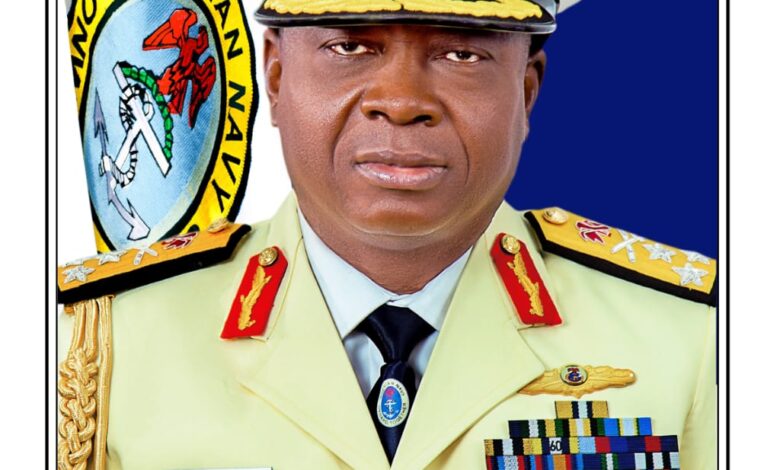
Alas, the new Chief of Naval Staff, Vice Admiral Emmanuel Ogalla, has since gone down to work by emplacing new measure to improve maritime security.
Just last week, the Chief of the Naval Staff (CNS), Vice Admiral Emmanuel Ogalla unveiled the need for the Nigerian Navy to leverage Artificial Intelligence (AI) and other emerging technologies to enhance the maintenance of Nigerian Navy platforms and other operational activities.
Artificial Intelligence (AI), is amongst the contemporary technology that is highly sought after, in all filed of human endeavour.
The CNS announced his administration’s willingness to put necessary mechanism, that will enable the service adopt AI in tackling maritime security, during the presentation of a paper by NN participants of National Defence College (NDC) Course 31, titled “Artificial Intelligence and Ship Maintenance: Strategic Options for the Nigerian Navy by 2035″.
The Spokesperson of the Nigerian Navy, Commodore Adedotun Ayo-Vaughan, in a statement quoted the CNS, as saying that the use of AI is significantly transforming the maritime industry and the NN is embracing it to improve the availability of ships towards enhancing operational effectiveness.
The CNS further averred that ships were increasingly becoming sophisticated with advancements in technology and the incorporation of AI and other emerging technologies in their construction.
Vice Admiral Ogalla, said, the NN must continue to adopt and integrate these technologies to maintain a competitive edge during operations, adding, that the paper is timely as it would invigorate the NN consciousness towards AI and other emerging technologies and their implication for operational effectiveness.
He commended the participants’ efforts at drafting a roadmap for transforming the Navy’s maintenance system into an AI-Compliant System, as well as their novel suggestion of the use of the In-Transit-Hull cleaning which would save the Navy a lot of foreign exchange from docking ships for hull cleaning.
Meanwhile, the Commandant National Defence College (NDC), Rear Admiral Olumuyiwa Olotu said, the presentation by NDC participants is an annual event under the College’s higher management of Defence package.
He posited that the choice of this year’s topic was deliberate considering that AI is an emerging technology that can enhance the Navy’s capabilities and efficiency in various aspects such as ship systems, weapons, networks, and command and control, which makes the participants’ research work very germane.
Rear Admiral Olotu, said, the strategies proffered by the participants would enhance the NN’s capabilities and operations, in line with Nigeria’s security objectives.
The Commandant assured that the College would continue to support the NN in its efforts to ensure a safe and secure maritime environment.
This is as the CNS, who is currently touring Navy formations and units across the federation, also, expressed zero tolerance on the alleged involvement of military personnel in oil theft.
Admiral Ogalla, said that the Nigerian Navy, under his command, would investigate rather than gloss over allegations of military involvement in oil theft, vowing that any personnel found culpable would be dismissed and prosecuted.
The CNS, who said this, while, interacting with newsmen in Port Harcourt, during his two-day tour of Naval formations and facilities in Rivers State, pledged that the Navy will scale up waterways surveillance, especially in the creeks, and strike criminal elements to end the menace of illegal crude oil refining and illicit bunkering.
He disclosed that the Service has recorded huge success in frustrating illegal oil bunkering activities across the maritime environment in the Niger Delta and beyond.
He drew public attention to the fact that most of the allegations against the military with respect to oil theft were false and unfounded.
According to him, “The issue of involvement of our personnel in oil theft, you know this is the age of social media. And many people who do not even have the full details, will just put something up there. But if you go through some of those allegations and you investigate them, you find out that the basis of those allegations are unfounded. For instance, somebody will just see a vessel somewhere and he will say oh! the military is involved. He doesn’t even know whether there is proper approval from the NNPCL for that vessel to load. But he will put it on social media that he saw some military men onboard a vessel and that vessel is involved in oil bunkering without having the correct information.
“But whatever the case maybe anytime we receive such allegation we investigate it properly. So far, our investigations have been showing that most of the allegations are not true. We still respond to them by investigating properly so that if there is element of truth in it, we hold the personnel responsible and we apply the law according to the Armed Forces Act. It has a very severe consequence ranging from imprisonment to dismissal. There has been such cases like that in the past and appropriate actions were taken”.
He also, posited that over 90 percent of those allegations are just based on social media hype without proper background.
Vice Admiral Ogalla used the opportunity to also, unveil few of his long-term measures, when he said: “We are going to improve surveillance capability because we want to be able to strike the criminals even before they go into the act. We want to arrest them while they are planning, while they are thinking about it. So, we don’t want to be on the defensive. We want to take the war to the criminals and get them even before they start the act”.
Reiterating the primacy of intelligence led operations and the application of modern technology, Ogalla said the Nigerian Navy, is trying to extend the coverage of its maritime domain awareness capability, the falcon eye to the back waters which is the creeks and the riverine areas which are where most of these activities takes place.
While in Onitsha, in continuation of his tour of units and establishments of the Nigeria Navy, Ogalla explained that the tour of units and establishments had become very imperative for him to assess the situation on ground, with a view to evolving strategies on how to improve on existing operations.
The CNS said: “We have seen some challenges and noted what to do, particularly in the area of policing the country and the fight against oil theft in the Niger Delta, which is one of the critical areas we have assessed and are mapping out strategies to improve on the anti oil theft. The purpose of this visit is to first of all see our units and establishments as they are so that we assess the situation on ground to find strategies on how to improve on our operations. We have seen some difficult challenges and the environment Naval Outpost Onitsha is operating in. We can see the effect of erosion on our shoreline, we have seen the fence that has collapsed. This particular unit gets flooded to the foundation, we have noted what to do and at the same time seeking the collaboration of relevant agencies and stakeholders to come to our aid in rescuing this particular unit from being completely submerged by erosion”.
He nevertheless, expressed joy that the challenges they face did not significantly impact negatively on their effectiveness.
In conclusion he said: “We have taken note of some of the things to do so that we can improve particularly in the area of anti oil theft which is one of the critical areas we are assessing to bring out strategies to improve our operations”.