1st COVID-19 vaccine (COVAX) doses administered in Africa – WHO

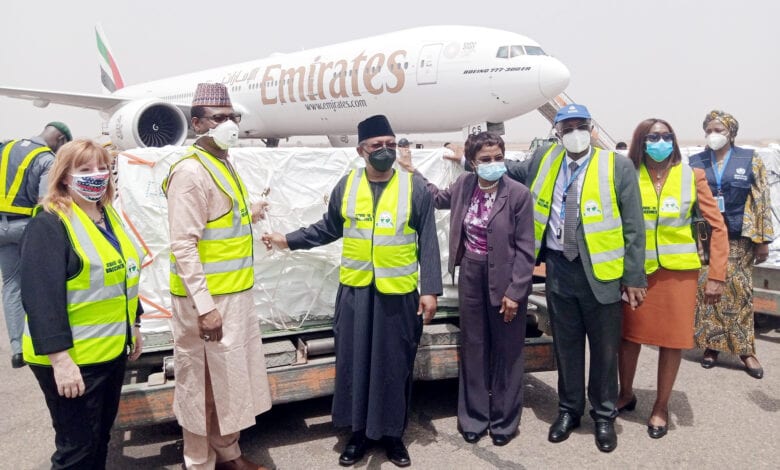
The governments of Côte d’Ivoire and Ghana, on Monday began COVID-19 vaccination campaigns aimed at protecting healthcare workers.
The World Health Organisation (WHO), Regional Office for Africa, disclosed this in a statement issued from its headquarters in Brazzaville, Congo.
According to the UN health agency, this week’s first vaccinations have been administered and a further 11 million COVAX doses are expected to be delivered over the next seven days.
“Publication of the allocation of the AstraZeneca/Oxford vaccine to 142 of COVAX’s participating economies, to be delivered between now and the end of May, is anticipated tomorrow (Tuesday).
“The AMC is the COVAX Facility’s mechanism to provide donor-funded vaccines to lower-income countries.
“The campaigns in Ghana and Côte d’Ivoire follow deliveries to both countries last week with Ghana taking delivery of 600,000 doses on February 24, and Côte d’Ivoire 504,000 doses two days later.
“Both countries received the AstraZeneca/Oxford vaccine licensed and manufactured by the Serum Institute of India (SII). The vaccine, branded COVISHIELD, was granted Emergency Use Listing (EUL) by the WHO on February 15.’’
The statement quoted President of Ghana, Nana Akufo-Addo, as saying: “COVID-19 has changed the world. It has cost lives, battered health systems, and damaged livelihoods.
“But, through these challenges, we have seen the best of humanity exemplified through strong multilateral cooperation.
“Ghana welcomes the arrival of the first doses of COVID-19 vaccines through the COVAX AMC as a pathway to ending the acute phase of the pandemic.
“To maximise the public health benefit of the vaccine, the first doses will be prioritised for health and essential workers, and other at-risk groups.
“This important milestone will allow Ghana to get back to business, and build back our economy even stronger than before.”
The deliveries mark the start of what will be the largest, most rapid and complex global rollout of vaccines in history, WHO said in the statement.
In total, COVAX aims to deliver at least two billion doses of COVID-19 vaccines by the end of 2021, including at least 1.3 billion to the 92 economies eligible for support through the COVAX AMC, it said.
The UN body disclosed that the confirmation of first-round allocations, covering majority of the COVAX facility participants, would be published on March 2.
“COVAX doses to date have been delivered by SII to India, Ghana, Cote d’Ivoire, while Pfizer-BioNTech has delivered doses to the Republic of Korea.
“More deliveries by these two manufacturers are planned in the coming days, with 11 million doses in total planned to be delivered over the next seven days.
“In addition, AstraZeneca is set to commence shipments this week.
“COVAX, the overarching effort to accelerate development and access to COVID vaccines, is co-led by the Coalition for Epidemic Preparedness Innovations (CEPI), Gavi, the Vaccine Alliance and the WHO, working in partnership with UNICEF, as well as the World Bank, manufacturers and civil society organisations, and others.’’
The statement also quoted Dr Tedros Ghebreyesus, WHO Director General, as saying; “This is a day many of us have been dreaming of and working for more than 12 months.
“It is gratifying to see the fruit of that labour. But success is still to come. This is only the beginning of what COVAX was set up to achieve.
“We have a lot left to do to realise our vision to start vaccination in all countries within the first 100 days of the year. There are just 40 days left.”
In addition, the statement quoted José Manuel Barroso, Chair of Gavi, the Vaccine Alliance, as saying, “as vaccination begins in Côte D’Ivoire, less than a year after COVID-19 was characterised as a global pandemic.
“I am filled with confidence, and I am sure that through COVAX and international solidarity, we will be able to reach the most at-risk everywhere.
“Global equitable access to life-saving vaccines is the surest way to save lives and rebuild economies.
“I would like to thank all donors and also the leadership of the G7 group of nations. Nowadays vaccine policy is the best economic policy,’’
“Similarly, Henrietta Fore, UNICEF Executive Director, said; “the last year has been a dark one for families all over the world, but the rapid development of COVID-19 vaccines provided a hopeful light at the end of the tunnel.
“Today, the COVAX Facility begins to make good on its promise to make sure that light shines for all.
“This unprecedented global effort has rallied the international community behind identifying acceptable vaccines, raising funds to procure them, and laying the groundwork for the world’s largest immunisation campaign in history.
“Now, these vaccines are quickly reaching people in low and middle-income countries, many of which would have been left behind without the Facility’s work.
“This proves what we can accomplish when we all – the private sector, UN and development agencies, governments, donors, and other partners – work as one.”
Dr Richard Hatchett, CEO of CEPI, said; “this is a historic day in the global fight against COVID-19.
“Today’s vaccinations in Cote d’Ivoire and Ghana are among the first to be delivered through COVAX, which will protect many hundreds of millions of those most at risk from COVID-19, wherever they are in the world.
Ghana receives 600,000 doses of AstraZeneca-Oxford vaccines from COVAX
“In the coming days and weeks, COVAX will begin to redress the global imbalance in vaccine deployment, but there is still much to do.
“The spread of new COVID-19 variants means global access to vaccines is more important than ever before, and the global community must remain firmly focused on this goal if we are to bring the pandemic to an end.”
According to WHO, the start of Africa’s biggest immunisation drive in history through the COVAX Facility marks a step forward in the continent’s fight against COVID-19.
“It is a welcome shift towards bringing African countries off the sidelines and back into the vaccination race, correcting the glaring inequity which has been an unfortunate hallmark of the global vaccine rollout to date.
“For months WHO teams in the region and partners have been supporting countries to plan and prepare for the complex challenges of such a massive vaccination campaign.’’
On his part, Dr Matshidiso Moeti, WHO Regional Director for Africa, said: “We now look forward to seeing these plans put into action with an effective and efficient vaccine rollout. (NAN)