By Seyi Odewale
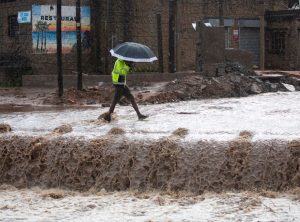
Two children have been reported dead after a recent flood incident in Nkwele-Awka, Anambra State. The children, whose ages are four and seven, lost their lives at two separate locations in the area.
One of them, it was gathered, was swept away while disposing of refuse along the flood plain, while the other died to pick his slippers from being carried flood water.
“She was pouring the waste inside the drainage when her leg suddenly slipped and she fell inside the drainage and was carried away by the heavy flood,” a resident of the area, Ify, said.
Also in Benue State, the state Emergency Management Agency (SEMA) has said no fewer than 700 houses and farmlands in Cheledi Community, Kirfi Local Government Area of Bauchi State have been destroyed by flood.
SEMA’s Director, Planning, Research and Statistics of the agency, Mr Adamu Nayola, who disclosed this in an interview yesterday in Bauchi, said the affected houses and farmlands were destroyed when the rivers in the area overflowed their banks in the wake of a heavy downpour.
He said: “More than 700 houses and farmlands were destroyed in Cheledi Community with rice, maize, sorghum, millet, sesame seeds and cowpea destroyed,’’ describing the incident as devastating and the worst to happen in the state this year.
628 Kano North varsity students to enjoy Barau’s scholarship scheme
According to Nayola, the flood has rendered many residents of the community homeless, adding that the Commissioners for Humanitarian Affairs, Housing and Environment had visited the area to assess the degree of damage.
“They assessed the level of damage caused by the flood in all the affected areas and provided necessary assistance to the victims,” the SEMA official said.
He also said most of the affected villages were on the bank of the stream.
Nayola said the agency was conducting enumeration of the affected houses and farmlands for the provision of relief materials.
He advised the public to avoid flood prone areas, blocking waterways with buildings to avert flooding.
The Anambra State police command spokesman, Tochukwu Ikenga, when contacted, said the death of the two children had not been reported to the command.
He, however, described the case as an environmental disaster, assuring of the command’s continued collaboration with the government to improve safety in the state.
“This is pure environmental disaster, but we keep working with the government to make sure safety is improved,” he said.
Meanwhile, the National Emergency Management Agency (NEMA) has advised Nigerians not to entertain fear over the release of the excess water from Lagdo Dam in Cameroon.
A statement by the Head of the agency’s press unit, Mr Manzo Ezekiel, yesterday, in Abuja, said the agency was working with critical stakeholders at the federal, state, and local governments to ensure that the release does not cause negative impacts.
He said efforts were already in top gear to prevent much havoc, especially on the low-lying communities along the states likely to be affected.
“The states downstream of River Benue are Adamawa, Taraba, Benue, Nasarawa, Kogi, Anambra, Enugu, Edo, Delta, Rivers, and Bayelsa.
“The agency envisaged this release of excess water from the Lagdo Dam, took note of the likely impacts, and considered in the preparations for mitigation and response to the 2023 flood alert.
“Information available from the flow level of River Benue at Nigerian Hydrological Service Agency (NIHSA) gauging station in Makurdi stood at 8.97 meters as of Aug. 25, compared to 8.80 meters on the same date in 2022.
“In contrast, NIHSA has also provided that the flow level of the River Niger system, specifically at Niamey, Niger Republic, remains stable at a normal level of 4.30 meters.
“Similarly, inland dams including Kainji, Jebba, and Shiroro reported consistent flow regimes. With regards to the hydrological station downstream, the confluence of the Niger and Benue rivers in Lokoja, Kogi State are currently within normal limits.
“The downstream monitoring station, however, registered a low level of 7.80 meters on August 25, compared to 8.24 meters on the same date in 2022,” he said.