

By David Lawani, Abuja
Nigeria’s vast deposits of gold, lithium, tin, limestone, marble and other strategic minerals were once seen as the country’s most promising pathway to diversifying its economy beyond crude oil. Today, however, those same mineral resources are increasingly emerging as one of the gravest threats to national security.
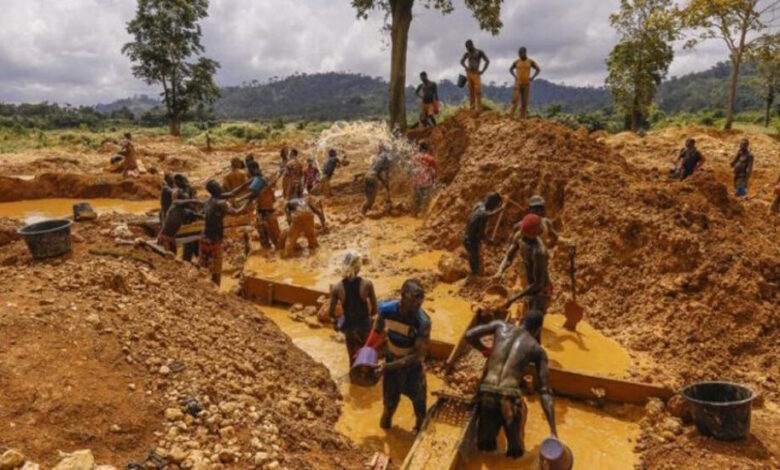
Across several states, illegal mining has evolved far beyond an economic offence. Security experts, mining stakeholders and civil society leaders warn that the illicit trade has become a major source of funding for armed bandits, kidnappers, terrorists and transnational criminal syndicates, creating a dangerous underground economy that fuels violence across the country.
From the gold-rich communities of Zamfara and Kebbi to the lithium deposits of Nasarawa, the tin fields of Plateau, the mineral belts of Benue, Niger and Sokoto, and the marble and limestone deposits in Edo and Kogi states, criminal networks have infiltrated mining communities where weak government presence has allowed illegal operators to flourish.
Instead of contributing billions of naira in taxes and royalties to government coffers, proceeds from illicit mining are allegedly being diverted into criminal enterprises, financing the purchase of sophisticated weapons, recruitment of armed gangs and expansion of violent operations across rural Nigeria.
Mining itself is not the problem. Around the world, responsible mining supports industrialisation, creates jobs and generates enormous public revenue. The challenge begins when extraction takes place outside legal and regulatory frameworks.
Illegal mining activities are often concentrated in remote forests and isolated communities where security presence is limited. These locations have gradually become safe havens for armed groups, who either provide protection for illegal miners in exchange for payments or participate directly in mining operations themselves.
Once criminal groups discover valuable mineral deposits in a community, violence frequently follows. Villages are attacked, residents displaced, traditional rulers intimidated, and legitimate economic activities disrupted as armed groups battle for control of lucrative mining sites.
Legal practitioner and mining policy advocate Okorie Kingsley believes Nigeria must fundamentally rethink its response to illegal mining by targeting the criminal economy behind the sector rather than relying solely on enforcement raids.
According to him, dismantling the financial and logistical structures sustaining illegal mining offers the most effective path to breaking the cycle of violence.
“The Federal Government can curb illegal mining by developing strategies that disrupt the economic and logistical roots of these syndicates. This includes intensifying financial intelligence, strengthening border control, and formalising Nigeria’s local mining sector,” Okorie said.
He argued that the government should intensify financial intelligence operations to identify illicit financial flows, monitor suspicious transactions and expose individuals and organisations profiting from illegal mineral exports.
Okorie also called for tighter border controls to stem the smuggling of illegally mined minerals while advocating the formalisation of artisanal mining through simplified licensing, technical support and regulated mineral markets.
He maintained that only a coordinated approach involving security agencies, mining regulators, financial institutions and border authorities would significantly weaken criminal syndicates operating across Nigeria’s mining sector.
Similarly, President of the Conference of Non-Governmental Organisations (CONGOS), Bartholomew Okoudo, urged the Federal Government to adopt what he described as a whole-of-government strategy to dismantle the criminal ecosystem surrounding illegal mining.
He stressed that stronger border surveillance, intelligence sharing and stricter enforcement of anti-money laundering laws were essential to cutting off the financial lifelines sustaining criminal groups.
“Success will depend not only on arrests but also on dismantling the financial, logistical and supply chains that enable illegal mining, arms trafficking, kidnapping and banditry to thrive,” Okoudo said.
He also advocated simplified licensing procedures for genuine artisanal miners, greater community participation in intelligence gathering and increased investment in education and alternative livelihoods to discourage young people from joining illegal mining networks.
For many analysts, Zamfara remains Nigeria’s clearest example of the dangerous nexus between illegal mining and insecurity.
Years of unregulated artisanal gold mining created enormous wealth for criminal groups, who fiercely competed for control of mining locations. Entire communities became battlefields as armed gangs fought over access to mineral-rich territories.
Although the Federal Government suspended mining activities in Zamfara at various times to disrupt the financial base of bandit groups, illegal operations reportedly resurfaced in many locations due to weak enforcement and the continued profitability of illicit mining.
The challenge has since spread beyond Zamfara.
Illegal mining activities have expanded into communities across Plateau, Niger, Benue, Sokoto and Edo states, where residents have repeatedly raised concerns over the influx of unidentified individuals operating outside established legal structures.
The growing involvement of foreign actors working with local collaborators has further complicated the situation.
While Nigeria’s mining laws permit legitimate foreign investment through licensed companies, reports of foreigners allegedly purchasing minerals directly from illegal miners have continued to raise concerns among industry stakeholders.
Because many transactions are conducted in cash, large sums of money circulate outside Nigeria’s formal financial system, making it difficult for regulators to trace the proceeds or identify beneficiaries.
The consequences extend far beyond revenue losses.
Mining communities have increasingly become targets for kidnappers seeking ransom from miners, contractors, transporters and traditional rulers. Forests surrounding mining sites equally provide convenient hideouts for criminal gangs holding victims in captivity.
At the same time, proceeds from illegal mining have allegedly strengthened illicit arms trafficking, allowing criminal organisations to acquire more sophisticated weapons and mount increasingly deadly attacks against communities and security personnel.
The result is a self-sustaining cycle in which illegal mining finances insecurity, while insecurity protects illegal mining.
Ordinary Nigerians continue to bear the greatest burden. Farmers abandon fertile farmland due to persistent attacks. Schools shut down. Healthcare services deteriorate. Businesses relocate. Thousands of families flee ancestral homes, while abandoned mining pits, polluted rivers and degraded farmlands leave lasting environmental damage.
The economic losses are enormous, but the human cost is even greater.
Experts agree that tackling illegal mining requires more than periodic arrests.
They advocate permanent joint security operations around major mining belts, compulsory biometric registration of miners, digital mapping of mining sites, tighter regulation of mineral transportation, enhanced financial surveillance, stronger border security, greater community participation and aggressive prosecution of illegal operators and their financiers.
Technology, including drones, satellite imagery and electronic monitoring systems, is also expected to play an increasingly important role in securing remote mining locations and improving regulatory oversight.
Nigeria’s abundant mineral resources should represent an engine of economic growth rather than a catalyst for violence.
Unless the country succeeds in dismantling the financial networks driving illegal mining, criminal groups will continue to exploit its mineral wealth to fund banditry, kidnapping and terrorism.
The challenge before the government is therefore no longer simply about protecting solid minerals. It is about protecting lives, safeguarding communities, and ensuring that Nigeria’s natural wealth serves national development rather than criminal enterprise.


