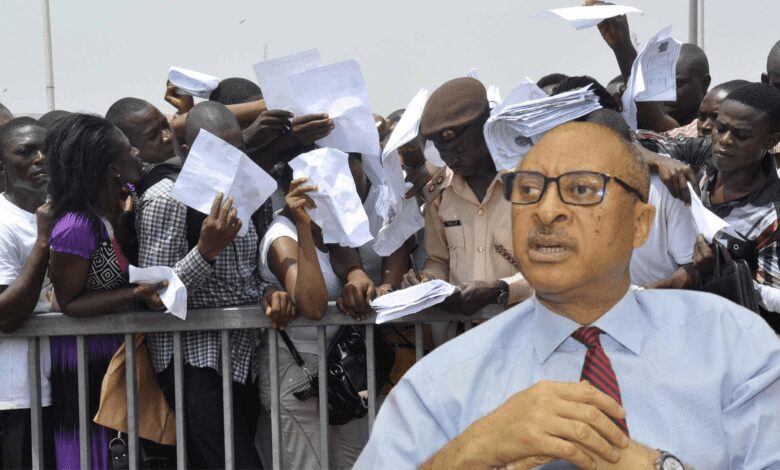
Renowned political economist and founder, Centre for Value Leadership, Prof. Pat Utomi, in this interview with Neta Nwosu, sheds more light on the challenges inhibiting the country’s economic growth.
The National Bureau of Statistics latest report on the rise of unemployment rate in Nigeria to 33per cent appears to indicate unemployment crisis in the country. What do you think are the solutions to this crisis?
Well, there are several ways out. Some of them require political maturity and leadership. For example, there is no way that you would not have a declined economic activity if everywhere is insecure. People for fear of their lives are not going to farms for example, so agricultural output will fall.
People who are going to make investments, they look at the atmosphere, they would hold back on investments. If you don’t make investments, there won’t be production, there won’t be growth. So one of the indicators for an economy where things are going on is what is called ‘Investment Confidence Index ‘just like the ‘Consumer Confidence Index.’
If the confidence is that, oh, I will earn some more tomorrow that makes a consumer to buy, if there is fear that this could be the last money, or let him better save up in case, things are going to go wrong, then he won’t consume.
If he doesn’t consume, somebody will not sell, if somebody does not sell, he would be retrenched and the unemployment rate would increase, so both the Investment Confidence Index and the Consumer Confidence Index need to be boosted and all of these lead to a simple but knotty political problem that can be solved only, if you have serving politicians who place a greater good above their petty interests. So, that is one dimension.
The second dimension is related in terms of investment. I don’t I know if I mentioned the last time we spoke about the Forbes article on Nigeria on May 28, 2019, in which a gentleman called Kenneth Rapoza described Nigeria as Africa’s money-losing machine.
So, if you want to lose money, go to Nigeria. Nigerian politicians and regulators are so reckless that the biggest source of business loss is actually government.
PDP commends Edo people’s confidence vote in Obaseki
Certain things like that have made Nigeria a very difficult investment destination for Nigerians and for foreigners. So, economic growth is going to be difficult in this kind of culture, so we need to change this political culture.
Then more immediately, and importantly, we need a strategy, we need a national strategy for growth and development, we don’t have one. We have the one that Vice President Yemi Osinbanjo was presiding over, the Economic Sustainability Committee (ESC).
But you see that is a technical kind of thing, it is not a grand strategy, but it is good. It is useful. But we have got to have a grand strategy. What is the general thrust of Nigeria’s grand strategy? It is not clear to me, at least, and I am sure it would not be to many more people.
I have always advocated that Nigeria should adopt a strategy rooted in what structure Economists would call latent Comparative Advantage, where you take your factor endowments. What are the gifts of Nigeria?
Is it Sesame seed? Is it Rum Arabic, whatever, take those areas, let education in those areas be oriented towards that product. If the kids in Benue State from primary one are being taught classes on Sesame seeds, by the time they are in secondary schools, they are literally geniuses in how to manage Sesame seeds and play in that value chain, before they leave secondary school, they are already entrepreneurs on the Sesame seed value chain.
Then in Nigeria, we dominate Sesame seeds value chain locally. We can do the same for rum Arabic in the North-West. We can do the same for hydrocarbon in the South-West, and in other zones.
However, we just lack that discipline, I am not sure why, but I suspect again that there is this triumph of politics which has made mediocratisation of public life the essence of Nigeria today. Nigerians believe that anybody can do anything, just put your person there, even if he has no clue what’s about. And this procedure, they don’t know what to do and they just make a mess of everybody’s life.
That’s what has happened to Nigeria. You have ministers who have no clue on what their ministries are all about — no creativity, no initiative, and the technocrats or permanent secretaries or bureaucrats are fed up any way. They know that these guys are all there to steal so they just find ways of collaborating with them to steal as much as they can so that they can get their share. Who pays the price? The whole country, very sad.
There is this belief that the middle class has been wiped off. Is this true?
I think significantly that has to do with the shrinking middle class. The middle class is such a formidable part of any nation’s development because they are the skilled knowledge people. They are the ones who get mortgages and because they have mortgages, they are committed to defending the system so they can have their desired quality of life so that they can be part of the society that keeps it going. What happens in Nigeria is because of the fact that the Nigerian elite is significantly a rent elite.
That is, they are not the production elite. They make their money from connection, they get this contract and all of that. So they don’t really hire a lot of people. The middle class people are in paid employment, they are not entrepreneurs; they have well paid jobs because they have good skills.
Well, many of the people who make money in the country make it from connection, just collect a piece of paper and hand it over to another person, stuff like that. You have fewer and fewer of these well educated people been hired. That’s why sadly, the people who are leaving the country the most are some of our smartest young people. You go to KPMG, Guaranty Trust Bank, they are all leaving in an amazing situation. At GT Bank, my account manager was changed three or four times in three months.
Each time they hand me over to some person, three weeks later, he is leaving for Canada and they hand me over to another person. So we have got a serious problem with the middle class through the shrinking and leaving, more than anything else and we don’t even see politicians making statements trying to encourage them and say ‘no, no, please don’t go anywhere, we trying to do this.’
They really don’t care. The politicians don’t care. If Nigeria can completely collapse as long as they can keep getting what they get from it, it doesn’t matter to them or they are not smart enough to realise the consequence, so they carry on the way they are carrying on. If they are really smart people, this would be the subject of conversation in the National Assembly, in the Executive Councils and all of these. But you hardly hear of such discussion going on, that is very dangerous for the country.
How do we reactivate the middle class?
Investments would reactivate them. It is investments that you make that will bring skilled people back into the system. Right now the smartest people are not likely to get the best jobs. They will be there, some nincompoops will come from somewhere because they are connected to somebody and they come from some place would put them above them. So they are not motivated, so they just either become passive observers or they leave.
So we need to build a new merit order. We need to build a new pressure for investment, creating industrial parks, creating all these vehicles for investments. Central Bank is talking about all these money they are pumping into sectoral sectors, and all the people in the sectors are saying that they are not seeing it.
We don’t see the money. We don’t see it because Nigerian politicians are also looking for how to grab such things and pocket it on the way and people who would actually produce sit there and they can’t raise the money. I can give myself as an example. I am in the middle of billions of naira worth of productive initiatives, but can I get one kobo from all these money? Not at all. But I’m sure that they are many people who are not producing anything, who are getting them, so that is the problem in terms of the political culture.