By Seyi Odewale
The Lagos State Government has intensified efforts to strengthen emergency response and fire safety across the state by expanding its firefighting infrastructure, deploying modern equipment, and recruiting additional personnel, following the rescue of more than 1,900 people and the protection of property valued at about ₦118 billion in 2025.
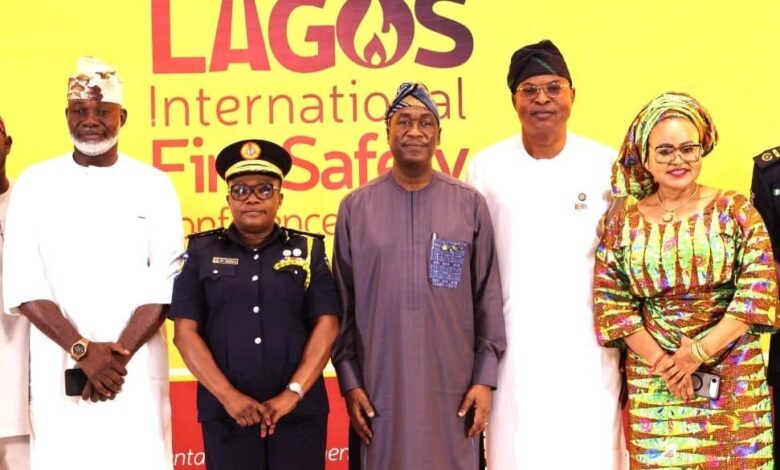
Governor Babajide Sanwo-Olu disclosed this on Monday at the opening of the Lagos International Fire Safety Conference 3.0 held at the Marriott Hotel, Ikeja, where he reaffirmed his administration’s commitment to building a more resilient emergency management system capable of responding swiftly to disasters while prioritising prevention.
Represented by Deputy Governor Dr Kadri Obafemi Hamzat, the governor said the state had commissioned 11 new fire stations, procured 62 modern firefighting vehicles, rebuilt the Lagos State Fire and Rescue Service Headquarters and recruited 150 additional firefighters, who are currently undergoing specialised training at the upgraded Fire Academy.
According to him, the investments have significantly improved the state’s emergency response capability and expanded the network of operational fire stations to 29, with new facilities already under construction in Yaba, Ikotun and Oworonshoki.
“We will continue to strengthen our emergency response capacity while placing greater emphasis on prevention, enforcement, public education and strategic partnerships,” Sanwo-Olu said.
The governor said his administration was also tightening enforcement of fire safety regulations through stricter building inspections and implementation of the Fire Safety Levy, stressing that compliance must go beyond documentation to ensure that fire safety systems remain functional at all times.
“Compliance must go beyond obtaining certificates to ensuring that safety equipment and systems remain fully functional,” he added.
Sanwo-Olu said the government had also introduced the Fire Marshal Programme, a community-based initiative designed to train volunteers in homes, schools, markets, offices, factories and places of worship to identify fire hazards, coordinate evacuations and support emergency responders before incidents escalate.
He urged residents, developers and business owners to embrace preventive safety measures, noting that reducing fire outbreaks requires collective responsibility rather than reliance on emergency interventions alone.
Chairman of the Lagos State House of Assembly Committee on Special Duties and Intergovernmental Relations, Hon. Olawale Rauf Age-Suleiman, described safety as a shared responsibility and called for stronger collaboration among government agencies, emergency responders and the private sector to reduce fire incidents.
Commissioner for Special Duties and Intergovernmental Relations, Olugbenga Oyerinde, said the conference underscored the need to shift attention from reacting to emergencies to addressing the root causes of fire disasters through innovation, public awareness and stronger preventive measures.
Controller-General of the Lagos State Fire and Rescue Service, Margaret Abimbola Adeseye, said the agency had undergone a remarkable transformation under the Sanwo-Olu administration through sustained investment in infrastructure, equipment, personnel development and operational efficiency.
She noted that the service’s improved capacity has enhanced emergency response across Lagos and significantly strengthened the protection of lives and property.
Also speaking, Chief Executive Officer of Sadeco, Vincent Effiong, stressed the need for greater collaboration among government, emergency agencies, and the private sector, saying that technology, innovation, and continuous capacity building remain critical to improving fire prevention and emergency response.
The conference brought together emergency management experts, safety professionals, regulators, and industry stakeholders to explore practical strategies to strengthen fire prevention and disaster preparedness in Nigeria’s commercial capital.