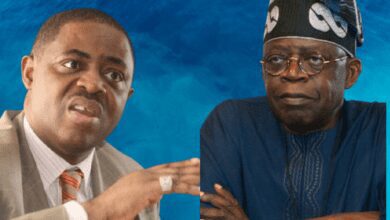
In the interview below, the National leader of the APC, Asiwaju Bola Tinubu, speaks on his life, political strategies, and the battles he has fought. He says the fight to oust former President Jonathan remains his toughest. His views are captured in The Big Interviews, a book on techniques for interviewing featuring top Nigerians by Eric Osagie
There are so many descriptions about you; some call you the game-changer, Field Mar-shall – that is what we crowned you with, the Field Marshall of Nigerian politics. You are the man who, from one state, hooked on to two, three states, and now the whole country. People say all kinds of things about you because of your role in the politics of this country; when you reflect and read all these things, how would you describe yourself? Do you sometimes ask, am I the one they are talking about? How do you see yourself?
It is quite interesting and challenging when you hear and see all these descriptions in the face of the complex political situation and the challenges of our country; the diversity of the nature of our politics, the struggle for democratization, the concept and principles of federalism and the challenges of good governance. I believe there cannot be good governance without democracy and democracy cannot also be achieved unless you have free and fair elections. People are not looking for perfection but in terms of materiality, it has to be substantially free and fair. How you define substantial compliance without mincing words is a challenge for every politician. My role as a politician is the determination to democratize my country, of indivisible commitment to democratic values, which can only come as you perform. I am not a thoroughbred politician, having come from a corporate background. I believe in strategy, and the strategy to win is that of every politician.
We can be politically sensitive and come up with the fact that you have to be a good politician, but no boxer steps into the ring to lose. No investor wants to invest to lose; otherwise, you can carry your money and throw it into the Lagoon. You’re there to win. How do you plan that strategy to win and come on top? That is where I always like to specialize. Then, there are elements of perversion, diabolical perversion in the political process. Particularly, in the maintenance of the status quo. Mine is to challenge the status quo if it is perverted. How do I challenge the status quo? When we came back in 1999 and the status political space was opened, we had our political party, the Alliance for Democracy (AD), the platform on which I contested.
AI raises alarm over right violation by the military in the ECOWAS region
The perversion started from the so-called delegates’ election. How could I say then that I wanted a free and fair election if you subscribe to the delegates’ election where you could buy people like chicken and pay them off or go to the market with apples? I said, let the Lagos people determine through the political party structure, who and who they wanted.
I created a crusade to eliminate that delegates’ corruption and we won. We won the debate and we now have direct primaries in all the local governments. Those who have followed southwest politics knew that it was a tough battle between Funsho Williams of blessed memory and myself. I won 17 local governments out of 20, and in two of them, there were no elections. They chewed the results in my local government, Ikeja. Lagos Mainland was the stronghold of late Funsho Williams and Ikorodu too with Ogunlewe and co. But we challenged the status quo because it was evident that I won that election, whatever- story anybody tells you. I still have that record. It is there. for everybody to verify I resisted the overturning of the results. Then, I was determined to form a government that was professionally and intellectually balanced to be a model for Lagos State. It is very easy for people to forget. If you recall, Lagos was described by the former president, Olusegun Obasanjo, as an urban jungle.
Then, we had to refuse dumps as high as skyscrapers. No hospital was functioning. We were just lucky that no epidemic like Ebola, Lassa fever, Cholera, and so on, occurred in Lagos State. If you were a regular person on Ikorodu Road, Oworonshoki, there was no day you would not see up to four or five dead bodies on the streets. I had a friend, an American, who visited me with his wife to felicitate me for winning the election. He used to work with us when I was in exile. They saw rotten dead bodies and vehicles mashed on them. The wife almost vomited blood. They planned to spend one week, but after 48 hours, they were ready to go.
That challenge was confronted. Today, if you talk to respected Prof (Yemi) Osinbajo who is now the Vice President of the country; he was a member of our cabinet; every cabinet member became a cleaner and refuse the supervisor to clear each street. It was then we established, through the respected Commissioner for Health, Dr. Leke Pitan, the analog telephone bank and center 123. We brought in ambulances. Initially, we were using rickety vehicles to convey dead bodies. We cleaned up Lagos and re-organized and re-engineered the finances of the state.
They were the three main focus areas. You cannot renew the infrastructure. That time, it could take six hours to move from one end of Kudirat Abiola Way to the other. I experienced it.
You could spend the whole day on Itire Road. It is very easy to forget all these things. You could not go through Adeola Odeku without spending the whole day. Akin Adesola was im- passable. Ozumba Mbadiwe was no road. Adetokunbo Ademola was no road. It would take you the entire day to move through Alimosho. These things have been entirely forgotten. We also faced the challenge of infrastructural deficit. Oil was trading at $9.50 per barrel and so the allocation was very poor. What we have now is a celebration, compared to what we had then. We were celebrating towards the end of our administration when the oil price rose to over $30. We celebrated that the federal allocation coming to Lagos was up to N100 million. It is very easy to forget. So, the challenge of enhancing the welfare of the people was there. You could not visit, for instance, LASUTH hospital without covering your nose with a handkerchief. You could not go to Marina and pass through the General Hospital without an offensive odor from dead bodies. No mortuaries existed. We faced the challenge of renewing Lagos and it happened.
No matter how beautiful your idea is, if you do not have the thinker, the doer, and the financial resources to face the challenge, there is nothing you can achieve; that can be progressive. I had the best hands then. I had a Wale Edun, a highly respected expert that I knew in the United States, in IBTC, what is today a successful new generation bank; I had him in charge of Finance and creativity.
He realigned all the ministries. There was also no courtroom; at Igbosere, you could hunt for rats there. You cannot believe this. When Prof Osinbajo took me there and we saw rats, we almost ran out because they were as big as rabbits. They were all over the courtroom. You wondered whether it was a human being or rats that was presiding. The spring on the chair in one of the Chief Justices’ offices was out of the cushion where he sat. I can- not forget that quickly. So, when you put all these together and you see Lagos today, I’m a very proud man. Then, I was in the opposition party.
It was a government in opposition. I had a military-civilian in former president Obasanjo that I had to contend with. He was passing through a personal transformation to become a democratized civilian. Those challenges are several chapters in the history of my transformation too, as a politician. After the National Democratic Coalition (NADECO) struggle to democratize Nigeria, sometimes, you forget that you are now in charge and no longer an activist. But what helped me was my private sector exposure having been trained as an auditor/ financial consultant at Deloitte and having worked as an auditor, and treasurer in Mobil. I put those experiences in place to develop a strategy for first, financial re-engineering of Lagos State and two, defense of the mandate against the insurgence of the Peoples Democratic Party (PDP).
One dead, 10 injured in Abeokuta -Sagamu expressway auto crash
In all you have said, leadership is very critical. How would you define leadership and what has your childhood personal upbringing got to do with it?
I will reverse it. I will first of all talk about my childhood days during which I was groomed for leadership responsibilities. The Tinubus is a famous family; famous mother, Magaji. I grew up in a very large and huge family in a compound system. We had cousins and nephews and all of that, living in the same place and that taught me to struggle. You would find such things very in- interesting in life. We had an aunt and her husband who had a bakery and you know bread-and-beans is a famous food in Lagos. If they wanted to give us bread, they would not give us one loaf each. They might just give us four loaves. As children, some- times, we fought over the loaves, forgetting that there were extra loaves in the house. When we were eating, it was the case of the quickest hand that takes the big- gest meat. It was a struggle. You would have thought that your stomach would have accommodated the entire bread without sharing adequately with your cousins, nephews, and brothers. And after food, it became fun. At Campos, Balogun where my mother had a shop, if you go in the morning, you would fight. If you were coming back home, you would fight and the day you came back with your uniform intact, you were lucky and would thank God. And when you arrived home, sometimes you got caned again. What happened to your uniform? The discipline of self-survival started there, from childhood. Each time, I look back at the survival instinct of that period. During the Race, Course was common for us to play our regular rubber football. We called it Toronto in those days. We could also go on a bike ride. On the bike ride, you fought; Toronto football, you also fought. You had bullies all over the place and if you did not confront the bullies, they would suppress you. I had this tiny figure, however, I had to struggle to survive among the giants.
So, that was a trait I developed from childhood until I left this country to complete my education overseas. And I would have been a musician. During the Ramadan festival, it was common to do Were. It is what we looked forward to. I always took part in it. I followed them around and I enjoyed it even though before 4 pm, you must be home. If you were locked out, you were in real trouble. The Fuji musician, the Barrister, was our captain. His late mother and my mum were very close and he would use that reason to always take me out until one day, my mother told me, “by 8 o’clock, I must see you in this house.” But I would still sneak out and follow the Were, music group. But I thank God almighty, all those things are history now. It is through the discipline of great parents of blessed memory that we had that and I was able to become what I am today. It was through their discipline and guidance. I can recall the day I left this country for the United States of America and I decided that it was enough to walk around. There was an event, I think it was the 50th birthday of Pa Awolowo or Mama H.I.D Awolowo, I think it was Mama Awolowo (she was very close to my mum). They were very close friends and they worked together as politicians. There was no corner in Oke-Ado, Awolowo’s house that I did not know as a toddler. We visited Ikenne and Tai Solari had a cold room at Mayflower School and we were asked to go there and pick the drink reserved for the reception after church hour. Kids, we finished that on time because we wanted to watch what was happening in the church. We were standing across the streets when we heard gunshots; I was extremely lucky that my late sister was coming out of the church across the street. I just moved underneath the tree to stop her vehicle from crossing and a girl standing beside me, Ganiyu Dawodu’s sister was killed. It was then that I decided that I should leave the country. I was devastated and I wanted to travel to America.
Talking about leadership, leadership is a challenge. You read a lot about good leadership but there are few books on bad leadership. But they exist. The capacity to challenge your curiosity about life and your environment; about any they exist. The capacity to challenge things that you are there to do is an innate trait that is developed positively or negatively by individuals.
Do you think leaders are born or made?
They are made. The chances that people are born into royalty or the upper class are there.
There was no corner in Oke Ado, Awolowo’s house that I did not know as a toddler.”
Those who have followed southwest politics knew that it was a tough battle between Funsho Williams of blessed memory and myself. I won 17 local governments out of 20…”