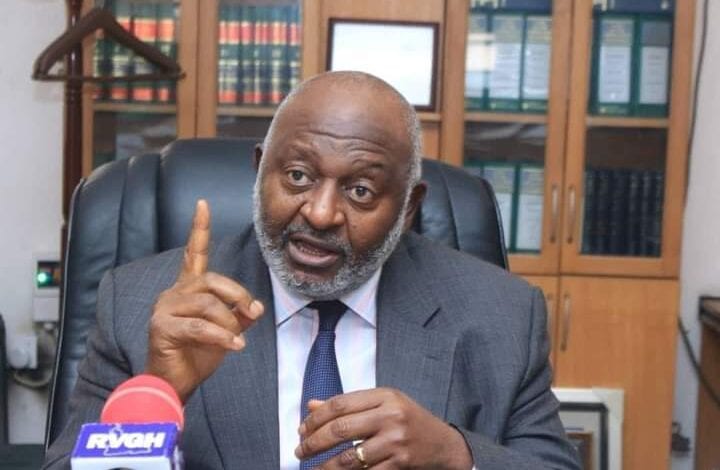
Former President of the Nigerian Bar Association (NBA), Chief Onueze C.J. Okocha, speaks on current clamour for the fiscal autonomy for the judiciary, the security situation in Nigeria and what can be done to ameliorate the situation, in this interview with Emma Obe
Why is it that the governors are finding it difficult to implement financial autonomy for the judiciary when the federal government is already doing it?
Let me say this; the picture is hazy. You said it has been done at the Federal Government level; I am not too sure about that. I know as a fact that the Federal Government is not sufficiently funding the federal judiciary in terms of capital expenditure and recurrent expenditure.
The Federal Government built the Supreme Court complex, the Court of Appeal complex, and the Federal High Court complex, all in Abuja. They also did the same across the states where they exist, particularly the Court of Appeal, Federal High Court and the National Industrial Court, all of which are part of the federal judiciary. Ditto for the Federal High Court of the Federal Capital Territory. So, I am not so sure that the Federal Government has implemented what is clearly stated in the Constitution that the funds for the recurrent and capital expenditure for the judiciary should directly be channelled after it had been approved by the National Assembly. They are to be paid over to the heads of the various courts concerned.
Should that be what we expect the states to do?
Now, when we come to the states, a few states have decided to give the judiciary what we call, some measure of financial independence. But I suspect that on account of the paucity of funds, the delays in the inflow of funds from the Federation Accounts, most of the states have not been able to do so.
Here in Rivers State, I am aware that the state government has given the judiciary what we call financial autonomy to the extent that immediately its budget is approved; once they are released and due, they will be paid over. But then the governor, thanks to him, seeing that the funding of the judiciary may not be enough to cater for capital expenditure, has been doing some capital projects for the judiciary here, and even some capital projects for the federal judiciary like the National Industrial Court, the Court of Appeal and the Federal High Court.
Lalong meets French Ambassador , discusses investment in mineral development , agriculture ,education
But the ideal situation, which our constitution provides for, is that judiciary monies should go to judiciary; let them spend it in accordance with their approved budgets.
That means that the anticipation of the constitution is that the judiciary ought to be executing their own capital projects?
The other problem is, of course, making sure that you insulate the judiciary from what we call award of contracts, because there may be implications of conflict of interests. Again, my own suggested solution is that all these are matters that we should go back to the table. We are now discussing amendments and review of the constitution. These are things once we find a clear way forward, they should be entrenched in the Constitution so that there can be no doubt about what the provisions are. And until this is done, there is no doubt that we will continue to have difficulties. I heard that, apart from Rivers and Ekiti states, one other Western state has also given the judiciary financial autonomy. But whether this extends to capital expenditure I am unable to say. That is why I say hazy picture; not so clear what is in operation. And of course, the JUSUN people would seize upon this as the justification for their strike.
You were saying awarding capital project contracts could bring about the likelihood of corrupting judicial officers…
No. I wasn’t talking of corruption. As I said, conflict of interest. A chief judge is heading a court, the court is awarding contract to build courts, and then the contractor defaults. The matter would end up in court and he, the chief judge, would now be presiding over either directly or indirectly, a case in which he is interested. They tried to insulate the chief justices and made the chief registrar the chief accounting officer of the judiciary. But it is still not a workable arrangement. So, we have to really know what the judiciary should handle when we are talking about its funding.
Let the government continue to build those structures as it is building for army, it is building for police, it is building for civil service. So, let it build courts as a responsibility of government so that you try to insulate the judges from matters in which they have personal interests.
The Niger Delta area, where you come from, is riddled with crises, most of which are related to oil exploration, pollution, company/community relations. Do you think the Petroleum Industry Bill (PIB) before the National Assembly can resolve these problems? Or will it require political action to resolve them?
We need the political will.
Personally, I feel that if the Federal Government under the Constitution has full mandate to deal with petroleum and petroleum resources, it has the full mandate under the law to deal with mines and minerals.
Of course, it makes sense that the federal legislature should legislate on the topic. As I said earlier, I don’t agree. In a true federation, each federating unit and the people who own the lands own the minerals because these laws: the Minerals Act, Mining Act and even this Petroleum Industry Bill that we are talking about; they seem to forget that the principle of law applicable to landholding is that each man who owns land owns all that is inside the land and above the land. They should go and learn from places like Canada, America and some of the developed countries. If you own land, you own the minerals. Let the Federal Government be a regulator and just a regulator, not an owner, not an operator just like we have now in Nigeria.
Let them make a Petroleum Industry Bill. But first and foremost, let them have in mind that the Constitution can change all that. If the Constitution says that each state owns the minerals within the states and the landholders in that state also own whatever is in their land, all these laws that are militating against the interest of the Niger Delta people will disappear.
So, my thinking on it is that we need to sit down and talk. Before Nigeria became a republic; in fact, just before Independence, the constitutional conferences agreed on derivation formulas. Nigeria’s mainstay then was agriculture. Oil and gas then had not become very prominent in revenue. And look at how most of the regions developed their regions.
Look at the Western Region, from cocoa; Eastern Region, from coal, palm oil, rubber. Same with what later became the Midwest Region. Northern Region from groundnut, hides and skins, cotton, because agriculture was such that if you go and till the land and you get good product, you own whatever you harvested and you can sell to those produce marketing companies as they called them in those days.
Again, it’s a constitutional problem. The Petroleum Industry Bill? Yes, because petroleum is under the Exclusive List. The National Assembly can legislate on it now. But even the legislation that they are proposing has talked about a certain funny percentage for the owners of the land where the minerals are. I hear that the leaders of the South-South said that they would take nothing less than 20 or 10 per cent, while the Act itself or proposed bill was recommending something lower.
In the old regions, it was 50 per cent for derivation. I heard one senator from the north the other day say, ‘all the minerals in Nigeria belong to us because they belong to Nigeria.’ Who told him? He went and lived there. If he digs deep in his land, he will find gold, he will find diamonds, he will find other minerals there, even uranium, which is very highly priced. So, again another constitutional problem, which Nigerians should sit down and talk about, and we agree on the way forward.
Do you think that Nigeria is on the brink, given the security situation that we have; insurgency in the North-East, banditry in the North-West and North-Central; the West and the East talking about regional security organisations…
Nigeria is on a precipice. It is on the brink and unless we sit down as Nigerians and in a very mature way solve our problems, we will continue to have difficulties. Why has insecurity reached such an abysmal level? People should ask questions. The law enforcement agencies like the police; the other one they call SSS; the other one they call security and civil defence; all federal institutions. And of course, you know what goes on at the federal level; quota system. They are recruiting people based on some bogus quota that they have allocated to them. It is not right.
Security is a neighbourhood thing. My grandfather used to tell me stories about how in the olden days, it was in the village. The villagers in that particular village would set up their own security unit. And they were mostly youths of the same village, the same community. A man was fighting with his wife in the village and killed his wife. A lone policeman came trekking from Ahoada, which was then our county headquarters to arrest the man in my village at Rumuokoro without a gun. In the meantime, the village boys had arrested the man and tied him up and they were waiting. The policeman came, took him by foot back to Ahoada.
So, security is not being well attended to. The police, over the years…I happen to be the son of a policeman who worked with the colonial police when policing was well done. Security is now cash and carry. Those who can afford it would have good security. And look at the way they recruit people into the police force. In those days before a man enters the police force, you must know him up to his basic background that there is no criminality in his family. These days we hear that former armed robbers, former kidnappers are being recruited into the police, some into the army, some into the SSS. They were to recruit people into the ministry of internal affairs the other day and a pandemonium arose, and several people died. Up till now, nobody has accounted for that.
So, sadly, I think that we need to rejig the security system in this country. The talk about state police is very relevant. The talk about local government police, it is very relevant, so that we can have a measure of good enforcement of law and order in Nigeria.