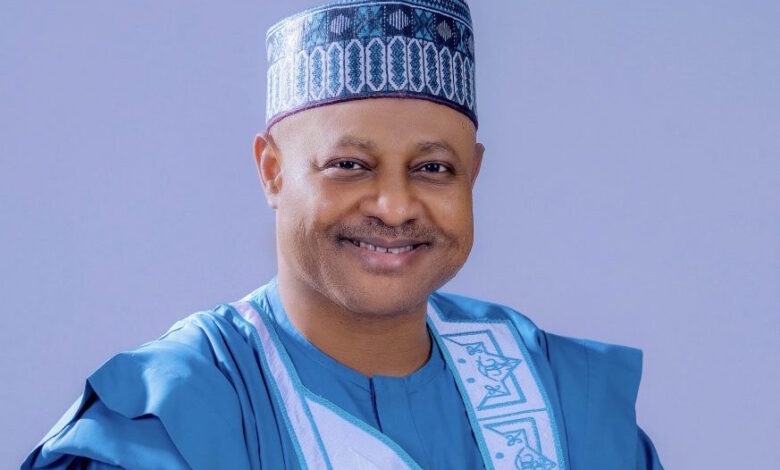
Kaduna State Governor, Uba Sani, says his administration is deploying skills acquisition, education, financial inclusion and infrastructure to tackle poverty and insecurity, insisting the state is safer than he met it. In this interview on Channels Television’s Politics Today, Sani speaks on vocational training, job creation, out-of-school children, debt repayment and security gains in troubled communities. He also explains why, despite increased revenues, his government has not borrowed a kobo. David Lawani reports
With increased revenues reportedly flowing to states under the Tinubu administration, what are governors doing with the additional funds?
But today, we are seeing the impact of how such resources are being deployed.
Could you explain the vocational training programme, you have set a target of training 32,000 young people, what is the central idea behind the initiative?
Thank you very much for having me again. When we came into office in 2023, we undertook a holistic assessment of our education system and identified areas where intervention could help address some of the challenges facing the state. One area we considered critical was skills-based education. Education is a major pillar of our administration, but we also understand that if you want to address challenges in education, healthcare and infrastructure, you must first confront unemployment and poverty. Addressing these issues will ultimately help in tackling insecurity. I have repeatedly said that many of the security challenges, particularly in the North-West, are driven largely by unemployment, poverty and hopelessness. We also discovered a significant skills gap in Kaduna State and Nigeria generally. If you look at refineries and other major industries, you will find that many skilled workers are recruited from outside Nigeria and even other West African countries. That shows we have a serious skills deficit. So, we partnered with the National Board for Technical Education (NBTE, conducted a needs assessment and established the Institutes of Vocational Training and Skills Development in Kaduna State. We agreed to build three campuses across the state’s three senatorial zones. In June last year, President Bola Ahmed Tinubu visited Kaduna to commission the institutes. The Kaduna campus was named after the late former governor, Balarabe Musa; the Zone Three campus after former Governor Sir Patrick Yakowa; and the Zone One campus after former Governor Col. Abubakar Dangiwa Umar. Our goal is to train at least 32,000 young people, particularly those from underprivileged backgrounds who are willing and able to acquire skills. Our partnership with the NBTE has been extremely helpful. Today, we graduated about 4,050 trainees. We also provided them with N810 million in starter grants. All 4,050 young men and women underwent rigorous training in about 14 different trades completely free of charge. We provide accommodation for those who choose to live on campus, while others can commute from home. Nobody paid a kobo because we believe human capital development is critical. Yes, we are building roads and hospitals and improving healthcare, but developing human capacity is equally important. Our assessment showed that many young people are roaming the streets simply because they lack opportunities. These graduates have received certifications under the Nigerian Skills Qualifications Framework, Level Two, which enables them to work in factories, corporate organisations and other establishments within and outside Nigeria. In fact, the NBTE Executive Secretary said we can export skills from Kaduna. Last month, the Minister of Education, Dr Tunji Alausa, wrote to us requesting permission for the Federal Government to adopt the operational manual developed for our institutes as part of its Technical and Vocational Education and Training programme. We developed our manual ahead of the Federal Government, and it has been recognised as meeting global standards. Professor Idris Bugaje, the NBTE Executive Secretary, who supervises technical education institutions across Nigeria, stated that our three institutes are better equipped than many federal universities of technology and polytechnics in the country. That is why the Federal Ministry of Education is interested in adopting our model.
The graduates were trained in areas including welding, solar technology, auto-mechatronics, catering, fashion design and computer technology. With N810 million shared among 4,050 graduates, that works out at roughly N200,000 each. Is that correct?
Yes. It is a starter grant to support them as they begin their careers or businesses. It is not a loan, and they are not expected to repay it.
Beyond the cash grants, were the graduates also provided with equipment?
Beyond the support, many of them are already securing employment. About 25 industries within and outside Kaduna have expressed interest in them. CGC, one of the leading construction companies, has employed about 42 of the graduates. As we speak, about 1,000 of them have secured jobs.
Did the Kaduna State Government directly facilitate those job placements?
We have been working closely with industries and encouraging them to give these young people opportunities. Representatives of some companies visited the institutes before the graduation ceremony, assessed the trainees and were impressed by their skills and qualifications. I do not doubt that these graduates will not be limited to opportunities in Kaduna. They can work anywhere.
Do you believe N200,000 is sufficient to help a graduate start a business?
Of course, N200,000 may not be enough, but the most important thing is to give them an opportunity and a foundation. As I said, about 1,000 of them have already secured opportunities in about 25 industries. We also have a team working closely with the graduates and prospective employers. I believe that within the next few months, many more will be gainfully employed. Some are prepared to become self-reliant and start their own businesses. Given their qualifications and the quality of equipment they trained with, I believe industries and factories across the country will be interested in recruiting them.
What mechanisms are in place to track the graduates and ensure this intervention does not become another failed empowerment programme?
This programme is designed to set them up for life, not merely hand them temporary empowerment. As I mentioned in my remarks today, one of our trainees recently emerged as the best in Nigeria in a national skills competition in welding and fabrication held in Abuja. That demonstrates the quality of training they have received.
So, these are graduates with skills that can be deployed anywhere?
Absolutely. I will continue engaging major industries and corporations to ensure that they have opportunities. Kaduna State has also established a Skills Council, which I chair. The council oversees the development of vocational training and skills acquisition in the state and will also monitor the progress of our graduates. About six months ago, Vice President Kashim Shettima, who chairs the National Council on Skills, wrote to commend Kaduna State for becoming the first state in Nigeria to establish a Skills Council at the sub-national level. What we are doing, therefore, goes beyond merely training young people.
Is the programme open strictly to Kaduna indigenes or to other Nigerians as well?
Kaduna is perhaps the most cosmopolitan state in Nigeria. As a government, we have made it clear that we have moved beyond the dichotomy of indigenes and non-indigenes. If you live in Kaduna, you are part of Kaduna. That is one of the things that makes our state unique. Kaduna has historically been the capital of Northern Nigeria and a place where people from different parts of the country come to live. Some of the graduates are not originally from Kaduna, but they were born and raised here or have made the state their home. We cannot deny them opportunities simply because of where their parents came from.
Many Nigerians watching will be interested in the opportunity. Who is eligible, and what qualifications are required for admission?
Some of the people we trained already have university degrees, while others have diplomas. The programme accommodates people with different educational backgrounds because the focus is on acquiring practical skills.
What is the minimum entry requirement?
The minimum requirement is secondary school education. Whether you have a degree or only a secondary school certificate, there is no discrimination. The most important thing is your willingness to acquire a skill. You do not need money, and you do not need to know the governor, a commissioner or any influential person.
How can interested applicants obtain admission forms?
We have an application portal through which interested persons can apply. Many of the people who graduated today did not know anyone in government. If you are serious about addressing these challenges, you must carry everyone along. Kaduna is perhaps the only state where we do not ask people which state they come from before giving them opportunities. Many people living in Kaduna were born and raised there. Why should we deny them opportunities when Kaduna is their home?
You have promised to scale up from 4,050 graduates to 32,000 annually. How will you fund and sustain such a significant expansion in terms of instructors, workshops, equipment and employment opportunities?
Let me clarify that. The three institutes have the capacity to train between 14,000 and 15,000 young people annually. You need to visit the facilities. As Professor Idris Bugaje explained, our workshops are larger and better equipped than many in federal universities of technology. Our campuses are comparable in size to universities because skills development is a major priority for us. There is also Panteka Market in Kaduna. When I came into office, Panteka was regarded as the second-largest informal skills hub in Africa, with at least 40,000 artisans operating there daily. We decided to collaborate with the NBTE to enable artisans at Panteka to obtain certification, even below Level Two, so they can advance professionally. Panteka handles highly specialised and complex technical jobs, attracting customers even from other West and sub-Saharan African countries. Today, Panteka has become the largest informal skills hub in Africa, overtaking Kenya’s Juakali, which had held the position for almost two decades. We have invested nearly N15 billion in infrastructure, modernisation and collaboration with the NBTE to provide certification. We do not want people to remain in the same position for decades without improving their skills. Many of them are educated but simply lack opportunities.
Research has consistently linked insecurity with poverty, unemployment and lack of opportunities. Was this one of the key considerations behind your skills development initiative?
Absolutely. When we came into office, we decided to examine insecurity in Kaduna realistically. We had about eight local government areas facing serious security challenges. More than 100 schools and over 100 primary healthcare centres had been shut down. Today, schools and primary healthcare centres that were closed are reopening. People often ask why Kaduna is experiencing relative peace and why other states want to understand our model. The model is simple: you must identify the symptoms and drivers of insecurity in your own environment. For us, poverty and youth unemployment were major drivers. So, we had to address them. The vocational training institutes are only one aspect of our intervention. Another was financial inclusion. When I came into office, I discovered that despite Kaduna being a major producer of commodities such as maize, ginger and tomatoes, many farmers lacked access to credit.
Why were farmers unable to access credit?
More than 70 per cent of them were unbanked and financially excluded. That is why I signed an Executive Order on financial inclusion, which enabled us to open accounts for about 2.6 million underserved and underprivileged people, particularly in rural communities. As we speak, Kaduna State has become one of the major beneficiaries of several Federal Government intervention programmes because we addressed the problem of financial exclusion.
How did you achieve that?
It is not rocket science. We simply addressed the challenge of financial exclusion and created the structures needed for people to participate in the formal financial system.
Kaduna was once regarded as one of Nigeria’s major centres of insecurity, with train attacks, kidnappings, killings and school abductions. Your government has also introduced a disarmament, demobilisation and reintegration framework in collaboration with the Office of the National Security Adviser. Would you say Kaduna has turned the corner on insecurity?
I can tell you categorically that we have made tremendous progress. Take Birnin Gwari, for example. It was once regarded as one of the epicentres of insecurity in Nigeria. Today, the situation has improved significantly. When I came into office, Birnin Gwari had not seen even one kilometre of road construction in about 20 years.
Why was infrastructure development impossible there?
Because of insecurity. Previous governments attempted to develop infrastructure along the Kaduna-Birnin Gwari corridor but abandoned the projects because of the security situation. Even President Bola Ahmed Tinubu experienced the situation firsthand. Before he became President, we discussed Birnin Gwari, and when he visited in 2022, he travelled with more than 21 armoured vehicles and a heavy military escort. Today, you can travel from Kaduna to Birnin Gwari even at midnight without a security escort. I reminded Mr President of that transformation and also reminded him of his promise to support the construction of the 122-kilometre Kaduna-Birnin Gwari road. Today, N178 billion has been released for the project, and construction is ongoing without any major security disruption. That is the same Birnin Gwari that was once considered a no-go area. The Kaduna State Government is also constructing another 36 kilometres of roads within the Birnin Gwari axis.
Who is handling the project?
CGC is handling it. The company has constructed several bridges and infrastructure projects in Kaduna, and none of its workers has faced serious security challenges in Birnin Gwari. So, yes, we are turning the corner. The same applies to other areas, including Giwa, although there are still pockets of insecurity. I will not sit here and claim that every security challenge has been eliminated. It is still a work in progress. That is precisely why we continue investing in skills development, job creation and poverty reduction. Government must recognise progress while continuing to address the challenges that remain.
Your government says it is taking more than 500,000 out-of-school children off the streets and back into classrooms. You also proposed about N246 billion for education in the 2026 budget cycle. What measurable outcomes should Kaduna residents use to assess the impact of that investment?
Let me clarify the figures. I was not the one who originally stated that we were taking back 500,000 out-of-school children. The Minister of Education, Dr Tunji Alausa, made that observation based on available records, statistics and data. When I visited him, he openly encouraged other states to adopt Kaduna State’s household mapping model for tackling the challenge of out-of-school children.
What exactly does the household mapping exercise involve?
It means we adopted a data-driven approach. Kaduna State undertook an extensive household mapping exercise, visiting thousands of households to identify children who were out of school. When we came into office, we discovered that Kaduna had about 550,000 out-of-school children. We did not arrive at that figure through guesswork; it was based on data gathered through the household mapping exercise. Having identified the children, we began implementing targeted interventions. Today, as the Minister of Education has acknowledged, we have returned more than 300,000 children to classrooms. But it remains a work in progress. That is why we have also sought partnerships with several development organisations and other stakeholders.
Looking back at your years in office, would you describe your performance as a success or a failure?
I believe we have recorded significant successes in several sectors, including agriculture, education, infrastructure, skills development and security.
Critics argue that your administration has received significantly more revenue than previous governments. How do you respond to that argument?
I do not like talking about these things, but I will say this: we inherited significant financial obligations. You can verify this with the Debt Management Office. We prefer to work quietly rather than engage in unnecessary publicity. We are paying about N6.7 billion every month from the loans and obligations inherited from the previous administration. Yet, since I became governor, Kaduna State has not borrowed one kobo. It is about prudence and making careful decisions about where public resources are invested. That is what leadership requires.
So, you are not dwelling on the difficult situation you inherited?
I do not believe in complaining about what I met on the ground. I prefer to focus on solving the problems.
But you inherited a difficult economic situation, didn’t you?
What I am saying is that we are paying about N6.7 billion every month from our FAAC allocation to service inherited obligations, and that arrangement will continue for years.
Are those payments for inherited debt?
The records are available at the Debt Management Office. You can verify them. But let me repeat: since I became governor, Kaduna State has not borrowed one kobo. I do not make claims without facts. When I speak, I rely on data and statistics, and whatever I say can be independently verified. That, to me, is the most important thing in public service.