By Peter David
For more than five decades, Nigeria’s economic fortunes have risen and fallen with the price of crude oil.
When oil prices rise, government revenues swell. When prices crash, budgets shrink, projects stall, and states scramble for survival.
But as the world gradually pivots away from fossil fuels and embraces cleaner energy alternatives, a new question confronts Africa’s largest economy: what comes after oil?
Increasingly, policymakers, investors and development experts believe the answer may lie not beneath the soil but beyond the shoreline.
Stretching across more than 850 kilometres of Atlantic coastline, thousands of kilometres of inland waterways and one of Africa’s busiest maritime corridors, Nigeria possesses one of the continent’s most significant yet underutilised economic assets — the blue economy.
It is an economy built around oceans, rivers and coastal resources: shipping, fisheries, aquaculture, ports, marine biotechnology, tourism, logistics, renewable energy and maritime services.
Globally, the World Bank estimates that the blue economy contributes trillions of dollars annually to economic output and supports hundreds of millions of jobs.
Yet in Nigeria, much of that potential remains dormant.
For Bayelsa State Governor, Senator Douye Diri, this underutilisation represents one of the country’s greatest missed opportunities.
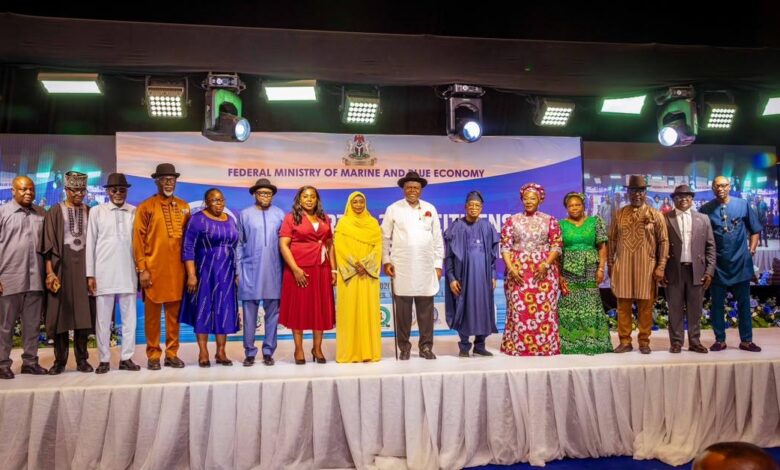
Speaking at the Federal Ministry of Marine and Blue Economy’s Second Quarter Citizens and Stakeholders Engagement in Lagos, Diri argued that coastal states can no longer afford to remain passive observers while opportunities sail past their shores.
“Of Nigeria’s over 850 kilometres of coastline, it is the coastal states that host these waterways. We must move from being spectators to becoming stakeholders.”
His argument touches a deeper national paradox.
Many of Nigeria’s coastal communities, despite being located near some of the world’s most valuable maritime resources, remain among the country’s poorest and least developed.
Communities that should be hubs for fisheries exports, shipping support services, marine processing industries and tourism continue to depend largely on artisanal fishing and monthly allocations from Abuja.
The result is a curious contradiction: abundance coexisting with poverty. Diri believes that the story can be rewritten, but only through deliberate political action. The first step, he argued, is institutional commitment.
“There is a need for coastal states to institutionalise the blue economy by creating focal ministries or agencies and giving them political and financial authority.”
Without institutions, policies often remain aspirations. Without budgets, ministries become signposts rather than engines of growth. The second requirement, according to him, is legislation.
Coastal states, he said, must enact laws that align with national blue economy policy while responding to the peculiar realities of their geography and communities.
“Investors do not gamble where the law is silent.”
Legal certainty, analysts note, remains one of the biggest determinants of private investment in large infrastructure and maritime projects.
Diri also challenged states to properly map their maritime assets, invest in coastal security and generate credible ocean data capable of attracting investors.
Piracy, oil theft, sea robbery and insecurity in coastal communities remain major obstacles to unlocking the full value of Nigeria’s marine resources.
The governor equally advocated the establishment of maritime skills hubs, modern fish processing centres and cold-chain facilities capable of reducing post-harvest losses and linking local producers to regional and international markets.
Bayelsa has attempted to position itself as a testing ground for many of these ideas.
In 2024, it became the first state in Nigeria to establish a dedicated Ministry of Marine and Blue Economy, following President Bola Tinubu’s creation of the federal ministry in 2023.
For Diri, the decision was not political symbolism but economic necessity. “To ignore the Blue Economy in Bayelsa would be to ignore Bayelsa itself.”
The state’s flagship maritime ambition remains the proposed Agge Deep Seaport.
Located close to international shipping routes in the Gulf of Guinea, the project has long been viewed as a potential game changer for the Niger Delta and Nigeria’s export economy.
Unlike Lagos ports, which continue to struggle with congestion, logistics bottlenecks, and limited expansion space, Agge offers the opportunity to open a new maritime gateway to Nigeria’s South-South region.
Diri sees it as much more than infrastructure. “It is not merely a port but a gateway vision for regional trade, logistics, industrial development, fisheries exports and wider integration within the Gulf of Guinea.”
The state government has already appointed a transaction adviser, while the project has progressed to the inception report stage as Bayelsa seeks private investors and federal support.
Beyond shipping, Bayelsa is also betting heavily on aquaculture.
At Yenegwe, the government has commenced the operationalisation of a 127-hectare Aquaculture Village designed as a production, training and enterprise hub.
The numbers are ambitious. A hatchery capable of producing more than three million fingerlings per production cycle. Five hundred grow-out ponds measuring 20 by 50 metres each. A feed mill with the capacity to produce up to 20 tonnes of fish feed daily.
For a country that spends billions of naira annually importing fish despite its extensive water resources, the implications could be significant.
The Federal Government shares that optimism. Minister of Marine and Blue Economy, Adegboyega Oyetola, noted that the successful implementation of the National Blue Economy Policy last year provided Nigeria with its first coherent framework for harnessing opportunities across its maritime domain.
“Effective implementation of the national policy cannot rest solely on the Federal Government.”
For Oyetola, coastal states, private investors and development partners must become active participants if President Tinubu’s economic diversification agenda is to succeed.
The private sector agrees. Representing President of Dangote Group, Aliko Dangote, the Managing Director of Dangote Ports Operations, Mr Simon Akin Omole, warned that Nigeria was approaching a defining moment.
“The decisions we make today will determine whether future generations inherit an untapped promise or a globally competitive economy that drives investments, industrialisation and shared prosperity.”
The warning is difficult to ignore. Countries such as Indonesia, Singapore, Norway and the United Arab Emirates have transformed maritime resources into pillars of national prosperity.
Nigeria possesses comparable advantages of geography and scale. What has often been missing is execution. As global oil demand gradually softens and energy markets evolve, the urgency becomes clearer.
The blue economy is no longer an alternative conversation. It is increasingly becoming an economic necessity. The age of measuring Nigeria’s prosperity solely in barrels of crude may be drawing to a close.
For the country’s coastal states, the next economic revolution may emerge not from oil wells or gas fields but from the oceans, rivers and coastlines that have always been there — waiting patiently for the nation to look seaward.
And if Governor Diri’s argument gains traction, the future of Nigeria’s prosperity may depend less on what lies beneath the ground and more on what flows above it.