By Babs Oyetoro
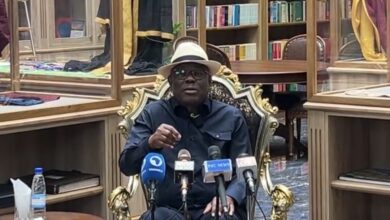
The nation’s oil and gas industry is enmeshed in confusion following reports of the purported resignation of the Group Chief Executive Officer of the Nigerian National Petroleum Company Limited (NNPCL), Mr Bayo Ojulari.
The controversy arose from allegations surrounding a $21 million corruption scandal, which moved Civil society groups, including OilWatch Nigeria and Workers’ Rights Alliance calling for Ojulari’s removal.
The protesters listed their demands to include an independent probe into alleged financial misappropriation related to recent fuel subsidy adjustments and offshore procurement contracts.
Some of the placards carried during Friday’s protest read: “Ojulari Must Go!”, “Who’s Looting NNPCL?”, and “We Demand an Audit Now!”
There are also unconfirmed reports that the embattled GMD is fraternising with leading opposition leaders to undermine the Tinubu’s administration. “He’s allleged to be secretly funding, through business concessions, to an ally of a prominent politician ahead of the 2027 election.”
An inside source within the system debunked the story making the rounds saying Ojulari has not resigned even as a reliabe source in the presidency described the claims as “speculative and baseless,” insisting there has been no formal communication suggesting a change in NNPCL leadership
“Mr. Ojulari remains the GMD. There is no presidential directive, nor has there been any internal memo suggesting a resignation,” the source disclosed.
In spite of the controversy surrounding the alleged removal of NNPCL boss, staff of the organisation have maintained sealed lips.
It will be recalled that the allegations of corruption from a leaked internal audit claimed that Ojulari is reportedly under scrutiny by anti-graft agency, Economic and Financial Crimes Commission (EFCC), which raised dust on the payments and opaque contract awards totalling N87 billion.
Although no formal charges have been filed against the leadership of the organisation, industry watchers say the growing public pressure is a culmination of months of discontent over the perceived lack of accountability since the company’s commercial transition under the Petroleum Industry Act (PIA).
Inspite of the public perception of the NNPCL under the watch of Ojulari, who was recently appointed GMD, he has yet to make a statement on the issue surrounding his purported resignation.
Most Nigerians have continued to express fears about the negative publicity generated by the current situation in the NNPCL, noting that it might have effects on the efforts of the government to attract investors to the country.
N75bn approved by FG for MSMEs yet to be accessed after two years —Minister Enoh
By Cross Udo, Abuja
The Minister of State for Industry, Senator John Owan Enoh, has expressed deep concern that the N75 billion intervention fund allocated by President Bola Tinubu for Micro, Small and Medium Enterprises (MSMEs) remains unaccessed nearly two years after its approval.
This revelation came as the MSME Finance CEO Forum and Awards initiative, a national platform committed to driving innovation and financial access for small and medium enterprises, signaled its readiness to collaborate with the government to ease financial constraints facing small businesses.
Speaking during a meeting with the MSME Finance CEO Forum and Awards delegation led by CEO Jude Ndu, the Minister highlighted that MSMEs are the foundation of economic development.
“MSMEs are critical — the pulse and even more than the backbone of the economy. Unfortunately, for decades, they have not been given sufficient attention,” he lamented.
Acknowledging the sector’s importance, the government established the Small and Medium Enterprises Development Agency of Nigeria (SMEDAN), which falls under his ministry’s supervision, to spearhead MSME growth.
Enoh also disclosed the creation of a financing forum aimed at addressing his mandate to facilitate MSME access to funds.
“We have a sum of ₦75 billion set aside as part of the presidential intervention fund for MSMEs. It’s nearly two years now, yet that money remains largely unaccessed—not because institutions have delayed processes, but because even those pre-qualified are unable to complete the required documentation,” he explained.
The Minister emphasized the need for financing models that address the informal sector, noting, “It’s not just about the big players in Abuja, Lagos, Port Harcourt or Kano. If you visit the hinterlands, you see people struggling daily to eke out a living. The question is, what kind of financing can be developed to meet their unique needs?”
He underscored the importance of affordable, long-term financing, referencing a recent technical session by the Industrial Revolution work group he set up, which focused on this thematic area.
“Our economy must become more productive through value addition and processing. This is the space the forum is being called to address,” he added.
Earlier in the meeting, Jude Ndu, CEO of the MSME Forum, said the visit aimed to explore strategic collaboration opportunities between the Ministry and banking partners to advance MSME development, industrial growth, and financial inclusion consistent with Federal Government priorities.
He formally invited Minister Enoh to be the Special Guest of Honour at the upcoming MSME Finance CEO Forum & Awards. Ndu highlighted that the Forum, now in its 5th year, serves as a convergence point for policymakers, financial institutions, and MSME stakeholders, with Access Bank and Keystone Bank as lead partners.
“We seek to create a strong public-private platform that unlocks MSME potential for job creation and industrialization,” Ndu said.
Representatives from Access Bank and Keystone Bank, major players in MSME financing, were also part of the delegation