Only NASS can review 16 years minimum age requirement for varsity admission- Adaramodu, Senate
‘Insecurity has not stopped us from carrying out oversight functions’

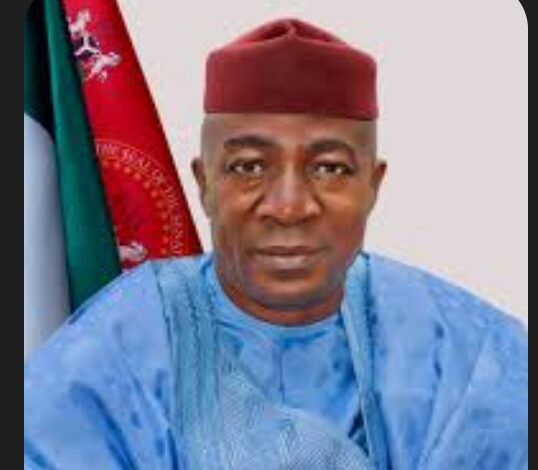
Chairman of Senate Committee on Media and Public Affairs, Senator Adeyemi Adaramodu, in this interview with journalists, says a possible upward review of the minimum age requirement for admission into tertiary institutions, is the mere opinion of some public officials, among others, NATHANIEL ZACCHAEUS, was there
Two senators have been quoted in the media to have supported the opinion of the Minister of Education that the minimum age requirement for admission into tertiary institutions should be pegged at 18 years. Is that the position of the Senate?
That is a comment. It is not a law. It is just a comment. It’s not a law. By the time the Senate resumes fully, whoever wants to bring that one out to make it a law, will bring it and then the procedures will take place because you can bring whatever to the floor in the form of a bill. When you bring it, there’s going to be a public hearing. All the stakeholders will sit down and talk about it, the parents, teachers, legislators, civil society organisations, and even foreign organisations. We will sit down and talk. Even if they say that the minimum wage should be 30 or 12 we will all discuss it at an open forum. It is still a comment which cannot be taken to be the law.
We also learnt that the minister had instructed the JAMB leadership not to release the result of those who are not up to 16 years
There is nothing like that. It cannot happen. When the prospective applicants bought their forms, there were no such conditions. So, when they have bought forms under one condition, that condition cannot be changed along the line until the current set of candidates has been successfully attended to. When the next engagement is to take place, then if the bill to increase the minimum age requirement is brought either as an executive bill or personal or private bill or the public brings it as a bill, then the National Assembly will now sit down and then allow it to go to the crucible of law-making. This is a country, this is Nigeria. So all of us will sit down and deliberate, oh, this is what we want, this is what we don’t want. So, far anything said about it is just a mere comment, it’s just an opinion. It is not law yet. So, once something is not law, then there’s a level of jaw-jaw that we can do.
Will the recent statement by President Bola Tinubu, asking federal lawmakers to reduce their frequent summoning of his appointees not hamper the oversight functions of the National parliament?
The president was once a senator. From my understanding, no minister, no head of any ministry, department, or agencies of the Federal Government will be summoned by the National Assembly without a reason. Even when we are being inaugurated, the President gives a directive and executive order to ministers and anybody who is managing any MDA to act and attend promptly to any summon and to answer any question that might be raised or arise from the National Assembly. So in the context, it’s not a negative comment passed by Mr. President. He is only saying that when and while any MDA head will be summoned, that person will be summoned based on substantial and substantive reasons and matters and that nobody in the National Assembly, no committee will call any head of any agency, frivolously. Nobody and no one. It is a standing rule in the National Assembly that you cannot call an MDA head without prior notice to them stating the reasons. It’s not going to be by phone call. It is not going to be by text message. It has to be stated in writing. The reasons must be stated in a letter. It is not going to be a chairman of a committee’s matter. It is going to be the whole committee’s matter. It must be on policy matter. It must be on delivery matter. It must not be about the internal affairs of that ministry or that agency. If it is going to be an internal matter of that ministry or that agency, whoever has any complaint against them must bring it in the form of a public complaint and through a petition. Such petition will be read by the concerned legislator at the open chamber for all senators to hear and then for it to be referred to the necessary committee to sit on it. So with this, Mr. President is only trying to tell heads of the MDAs and the legislature to find a coordinated nexus of meetings when and where necessary and that result will be to enhance governance and development. So it is not an indictment on the legislature. It is just that some people are trying to misread the semantics of Mr. President’s words.
Are you satisfied with the legislative performances of the 10th Senate so far? Should we expect something different from what usually happens in the past?
The legislature performs three-pronged functions. It makes laws, it carries out oversight, and at the same time, it represents the people. Lawmakers ensure that they always get across to their constituents give them feedback and advocate for them. So, those are the three very major functions of the legislator. On the issue of law-making within the chambers, the 10th National Assembly, especially the Senate, has done tremendously well because we have passed a lot of motions, life-changing, life-enhancing motions. We have passed motions on the economy, infrastructure, and security especially. We’ve done a lot. In terms of bills on security, arms proliferation matters, and trust funds. We have also legislated on the petroleum tax law, and several others like that. On the issue of oversight, yes, we are doing great.
When should Nigerians expect aggressive oversight by lawmakers of the MDAs?
The first budget that the 10th Assembly passed was the 2024 budget. It will soon start running because the last budget of 2023, which was not passed by the 10th Assembly, is still running. It is by May that the l 2024 budget will start in full force, that we can start to find the milestones where we are, and what we have done. We will look at what the MDAs are doing with it. Apart from that, the oversight functions of the National Assembly are not fully limited to the issue of budgetary performances of the MDAs. Outside that, public interest matters. Like when we talk of labour matters, when we talk of even electoral matters when we talk about inflationary matters when we talk about security matters when we talk about even at times disasters. So those are areas that we have been having oversight.
Some committee chairmen have cited insecurity as a reason they can’t go on oversight. What’s your reaction?