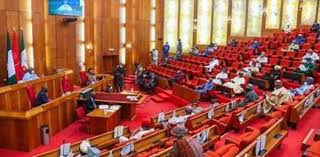
The Senate has called on the Federal Government to immediately launch diplomatic and humanitarian interventions to rescue hundreds of Nigerian women and children trapped in Libyan prisons, many of whom are victims of human trafficking, slavery, and sexual violence.
The resolution followed a motion sponsored by Senator Aniekan Etim Bassey (APC, Akwa Ibom South), who raised the alarm over the plight of Nigerians held in detention centres across Libya under inhumane conditions.
Senator Natasha Akpoti-Uduaghan (Kogi Central) moved a supplementary motion mandating the Nigerian Immigration Service and the Nigerian Correctional Service to collaborate with Libyan authorities to fast-track the release of detained Nigerian women and their children born in custody.
The motion, seconded by Senate Leader, Opeyemi Bamidele, received unanimous backing from lawmakers.
Akpoti-Uduaghan decried the “double victimisation” suffered by many of the women, explaining that most were deceived by traffickers with false promises of employment abroad but ended up being forced into prostitution or domestic servitude.
Akpoti-Uduaghan said, “These women have suffered double victimisation, first from traffickers who exploited their desperation, and then from a system that criminalises their suffering.
“Many were sexually assaulted in custody, resulting in pregnancies. Their children, born behind bars, are innocent victims of a cruel cycle of exploitation.”
In his lead debate, Senator Bassey described the situation as a humanitarian tragedy demanding immediate state action.
He lamented that Libya had become “a corridor of death and despair” for Nigerians seeking irregular migration routes to Europe.
Citing recent statistics, he said about 1,000 Nigerians were repatriated from Libya in the first quarter of 2025, many of whom recounted experiences of torture, forced labour, rape, and starvation.
He narrated the harrowing case of a young Nigerian woman, Mercy Olugbenga, who sold her family’s property to travel to Libya only to be held captive for over a year, during which her blood was allegedly extracted and sold.
“It is horrifying to realise that slavery still thrives in our modern world,” Bassey said.
The Senate referenced reports from Amnesty International and the International Organisation for Migration (IOM), which documented widespread human rights abuses in Libyan detention centres, including sexual violence, arbitrary detention, and extrajudicial killings perpetrated by both state and militia actors.
Following a heated debate, the Senate adopted a series of resolutions aimed at securing the release, repatriation, and rehabilitation of affected Nigerians.
It urged the Federal Government, through the Ministries of Foreign Affairs and Humanitarian Affairs, as well as the National Agency for the Prohibition of Trafficking in Persons (NAPTIP), to implement a comprehensive reintegration programme for returnees.
Lawmakers said the proposed plan should include psychosocial support, vocational training, and start-up grants to enable survivors to rebuild their lives and reintegrate into society.
Additionally, the Senate called for strengthened diplomatic engagement with Libya and collaboration with the African Union (AU), the Economic Community of West African States (ECOWAS), and the United Nations to ensure protection for Nigerian detainees and accountability for human rights violations.
The upper chamber also mandated its Committees on Diaspora, Judiciary, Human Rights, and Foreign Affairs to investigate trafficking networks and illegal travel syndicates facilitating irregular migration to North Africa.
The objective, as resolved by the Senate, is to identify perpetrators, close loopholes, and strengthen Nigeria’s anti-trafficking laws.
Senator Ali Ndume (Borno South) successfully proposed an amendment directing NAPTIP to play a lead role in the repatriation and rehabilitation exercise while working closely with relevant Senate committees to expose cross-border trafficking rings.
Another amendment by Senator Adams Oshiomhole (Edo North), seconded by Senator Ned Nwoko (Delta North), urged the National Orientation Agency (NOA) to intensify public awareness campaigns nationwide on the dangers of irregular migration and fraudulent job offers abroad.
Several lawmakers expressed outrage at the suffering of Nigerian women and children in Libyan prisons.
Senator Anthony Ani (Ebonyi South) described the situation as “a moral stain on the nation’s conscience,” insisting that the Federal Government must treat the matter as a humanitarian emergency.
Senator Victor Umeh (Anambra Central) condemned what he called Africa’s “shameful silence” on the issue.
He urged the African Union to hold Libya accountable.
“Africans are treating fellow Africans worse than animals. This level of cruelty should not go unpunished,” Umeh said.
In his remarks, Senate President Godswill Akpabio commended Senator Bassey for raising the motion and directed the Committee on Legislative Compliance to monitor the enforcement of the Senate’s resolutions.
Akpabio also cautioned Nigerian youths against falling prey to traffickers masquerading as travel agents or foreign recruiters.
He said, “Home is Home. Those who abandon the safety of our land for false promises abroad often end up in pain.
“Let us rebuild our nation together, because there is no greater pride than being safe, free, and productive in one’s homeland.”
The Senate’s intervention marks one of the most extensive legislative efforts in recent years to address the plight of Nigerians trapped abroad.
It also underscores growing parliamentary resolve to combat human trafficking, irregular migration, and the systemic exploitation of vulnerable citizens.
*NASS promises to complete Electoral Act Amendment by Dec 2025 for 2027 polls
The Leader of the Senate, Senator Opeyemi Bamidele, has assured Nigerians that the ongoing amendment to the Electoral Act, 2022, will be completed on or before December 2025, to ensure its full implementation in the 2027 general elections.
Bamidele, who represents Ekiti Central Senatorial District, gave the assurance on Tuesday in a statement issued shortly after President Bola Ahmed Tinubu requested the Senate to confirm Professor Joash Amupitan (SAN) as the new Chairman of the Independent National Electoral Commission (INEC).
Tinubu had forwarded Amupitan’s name to the Senate for confirmation following the unanimous approval of his appointment by the National Council of State last week.
The law professor succeeds Prof Mahmood Yakubu, whose tenure recently ended.
According to Bamidele, the National Assembly has learnt from past experiences. It will ensure that the proposed amend
ments are concluded well ahead of the next general elections to avoid delays that previously hindered presidential assent.
“The only reason the last administration did not sign the final amendment of the Electoral Act in 2022 was because it was transmitted to the Presidency too close to the general elections,” Bamidele said.
He explained that the National Assembly had initially sent an earlier version of the Bill, which former President Muhammadu Buhari signed into law. However, when lawmakers sought to correct the disenfranchisement of statutory delegates, the revised document was returned late.
“Late President Buhari noted that the Bill was coming too close to the elections and feared the public could misinterpret it, hence he withheld assent. Between now and December 2025, we will ensure that the amendment of the Electoral Act is completed early enough to guide the 2027 polls,” the Senate Leader assured.
Bamidele, who also serves as the Vice Chairman of the Senate Committee on the Review of the 1999 Constitution, said the current amendment process would be thorough and inclusive, involving key stakeholders such as the Nigeria Governors’ Forum (NGF) and the Conference of Speakers of State Legislatures.
He dismissed speculations that the Presidency might oppose the ongoing review, saying all arms of government are working together to strengthen democratic institutions.
“I do not foresee any form of resistance because relevant public institutions are collaborating with the National Assembly for the successful review of the 1999 Constitution. Global best practices will be adopted, especially in domesticating international treaties and agreements that enhance governance,” he stated.
Reacting to criticism from opposition parties, Bamidele maintained that the ruling party remains focused on its development agenda despite political distractions.
He said, “No matter how well a government performs, the opposition will never agree it is doing well because their goal is to reclaim power.
“They would prefer to see conflict between the executive and the legislature. But our focus is on rebuilding Nigeria, stabilising the polity, and growing the economy, and we will not be distracted.”
Bamidele further disclosed that the third legislative session of the 10th National Assembly would prioritise key reforms, including the amendment of the Electoral Act, the review of the 1999 Constitution, and other bills aimed at improving governance and accountability.
He added, “We have a lot to address in this session, from refining our electoral process to strengthening constitutional provisions that promote transparency and inclusion.
“The Senate is determined to complete these reforms in good time so that Nigerians can begin to experience the benefits before the 2027 elections.”
Bamidele’s comments come amid renewed efforts by the National Assembly to reform Nigeria’s electoral and constitutional frameworks, a move seen as crucial to ensuring credible elections, political stability, and deeper democratic consolidation ahead of the next electoral cycle.