

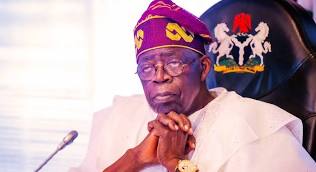
By David Lawani and Cross Udo, Abuja
President Bola Tinubu on Sunday admitted that the country’s harsh economic realities and lingering security challenges continue to weigh heavily on him.
He said he has “lost sleep and weight” over the difficulties confronting Nigerians, moments after emerging as the All Progressives Congress (APC) presidential candidate for the 2027 general elections.
Tinubu spoke in Abuja shortly after polling an overwhelming 10.99 million votes to defeat his only challenger, Stanley Osifo, who secured 16,504 votes in the party’s nationwide direct presidential primary conducted across 8,809 wards nationwide.
The President was subsequently presented with the APC’s 2027 nomination certificate at the Bola Ahmed Tinubu International Conference Centre amid loud celebrations by party loyalists, governors, lawmakers and senior party officials.
Addressing party delegates and supporters after accepting the nomination, Tinubu acknowledged the growing hardship in the country and defended his administration’s controversial economic reforms, insisting they were necessary to rescue Nigeria from fiscal collapse.
“Many Nigerians still struggle with rising costs and economic adjustment. We do not dismiss these concerns; we understand them and govern not in comfort, but in reality — with honesty and action,” Tinubu said.
In an emotional moment during his acceptance speech, the President declared, “I also lose sleep and weight over the economy and the security of our people, but the work we began is unfinished.”
Tinubu said his administration inherited a fragile economy, weakened by fuel subsidy payments, an unstable exchange rate, and deteriorating infrastructure, insisting that the reforms introduced since 2023 were beginning to yield results.
“We moved away from wasteful fuel subsidies, unstable exchange rates and weak infrastructure. Today, we are witnessing a turnaround: the naira is strengthening, foreign reserves are rising, and our economic outlook is positive,” he stated.
The President also cited what he described as key achievements of his administration, including the disbursement of over N282 billion under the Nigerian Education Loan Fund to more than 1.5 million beneficiaries, expansion in power generation capacity and reforms in the oil and gas sector aimed at attracting fresh investments.
On insecurity, Tinubu admitted that parts of the country remained under severe threat from banditry, terrorism and violent crimes, but assured Nigerians that his administration was intensifying military operations and security reforms.
“We will not rest until we restore peace and stability to every corner of our country,” he declared.
Tinubu also renewed his push for state police, urging the National Assembly to amend the Constitution to allow sub-national policing urgently.
“We also expect the National Assembly to amend the Constitution to allow the creation of State police as a matter of national emergency,” he said.
The APC candidate urged Nigerians not to abandon the ruling party midway through what he described as a difficult but necessary reform process.
“This next election must not merely be a contest of parties or ideas, but a reaffirmation of Nigeria’s democratic maturity. Let’s not give in to complacency by allowing politicians with no clear alternative vision to take our country backwards,” he added.
*Party hails direct primary, amid disquiet
Earlier, the Chairman of the APC Presidential Primary Election Committee and former Senate President, Pius Anyim, formally announced Tinubu as the winner of the direct primary election and described the exercise as a watershed in Nigeria’s democratic evolution.
Anyim said the APC had become the first political party in Nigeria to adopt the direct primary system for presidential nomination, arguing that the process would deepen internal democracy and eliminate the corruption associated with delegate-based primaries.
“The APC has become the first political party to adopt the direct primary election model for its presidential primary election,” Anyim declared.
He added that the exercise represented “a landmark step toward electoral transparency, inclusiveness and democratic reforms.”
Despite the celebration surrounding Tinubu’s emergence, the direct primary process reportedly generated disquiet in some quarters of the party, with concerns raised over logistics, accreditation procedures and the credibility of some ward-level figures.
However, Anyim dismissed fears over the integrity of the exercise, insisting that the process remained transparent and open to scrutiny by observers, the Independent National Electoral Commission and members of the diplomatic community.
“We are all winners,” he said. “When the final result is declared, the winner should wear his crown with humility, knowing that victory is a trust from the people.”
Tinubu secured a clean sweep in all 36 states and the Federal Capital Territory, recording 100 per cent of the vote in several states, a development party officials described as a strong endorsement of his leadership ahead of the 2027 presidential election.
Although heavily defeated, Osifo recorded pockets of support in a few states, polling 5,248 votes in Niger State, 2,675 in Kano, 1,186 in Lagos, 1,007 in Abia, 929 in Oyo, 779 in Benue and 768 votes in Nasarawa State.
The outcome further consolidates Tinubu’s grip on the ruling party and effectively positions him as the APC’s standard bearer in what is expected to be a fiercely contested 2027 presidential election.


