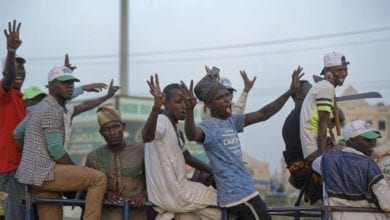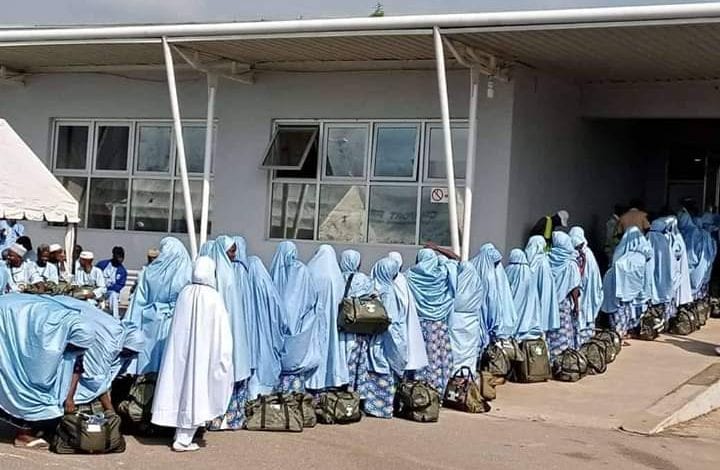
A deportee from Saudi Arabia, Amina Hassan, who confirmed this as much to ThisNigeria, likened the life at the Abuja camp as ‘hellish’.
With a visage filled with agony, Hassan noted that water, which she described as ‘ordinary’ is a golden item at the camp. The young lady, who urged Nigerian authorities to do something urgently about the camp, added that mosquitoes feasted on them at night even as they lacked access to good medication.

“Please follow me and don’t mind those telling you to come back because they lied to us. They told us that everything is okay at the camp here but when we arrived in Nigeria, we have realised that the situation is a different ball game.
“In Saudi, you are well taken care of and there is constant water to do your washing and flushing of the toilets. Just take a walk here, see the places they call toilets. They have not been flushed since yesterday and people have abandoned the facility to litter the ground with faeces.
“You can as well find out from other returnees, if I am not telling the truth. The food is not even regular, unlike what they told us at the airport. We buy food from vendors whenever food is not provided at meal time. And the worst of them is lack of drinking water and I do not know when I will be leaving here”, she lamented with tears rolling down her cheek.
For 42-year-old Hadiza from Kaduna State, she was not deported but voluntarily returned to Nigeria. According to her, she was stranded in Saudi Arabi following the incidence of COVID-19 pandemic.
Like Hassan, she complained of the unbearable life condition in the camp without functional facilities such as toilets. She declared, “Sleeping on bare floor is quit a hard nut to crack coupled with the effects of mosquitoes which cause sleepless nights. I consider life at this camp as frightening”.
Twenty-four-year-old Mohammed Sadiq also rues the non-availability of essential amenities at the camp. Sadiq, who said he looked forward to leaving the camp soon, described the place as a ‘dehumanising site’.
He said, “I know it might not be easy in the camp but not to level of lack of water and poor electricity supply. There are no mosquito nets here and that makes things worse. My focus now is to go and find something doing because I know that here does not represent my home”.
The inhuman treatment
For returnees, Florence Opeyemi from Oyo State and her friend, Nefisatu, a seamstress from Osun State, though their stories vary, they also revolve around inhuman treatment.
Twenty-seven-year old Opeyemi said, she has been exposed to ridicule by the slave masters, beaten by the children of her master before handing her over to the authorities which sent her to the Saudi deportation camp. Her worry now is that even in her home country, Nigeria, life has not been kind to her.
“Oga, please it is a long story but I will just be brief about what young girls go through in Saudi Arabia, Lebanon and Dubai.
“I am a graduate, from College of Education Oyo State. On graduation, I worked in one of the hotels in Ibadan until one of my friends came and promised to help me travel out of the country. That was how I found myself in Jeddah, Saudi Arabia. I was employed as a house help. I was working 20 hours every day, serving a family of over 10 persons. I was molested, raped by father and son, my salary for six months wasn’t paid. It was when I demanded for my money that the children of my boss gathered and beat the hell out of me and called in the police, who later sent me to the deportation camp.
“I am happy to be back home. Many have died in Saudi Arabia, Lebanon and Dubai, due to maltreatment. Many have been raped by fathers and their sons. I want to appeal to Nigerians, especially young girls not to travel to these countries because there is nothing special there. The situation is that they hate the blacks, you see one minute the Arabs will laugh with you, the next moment, they will kill you.
“I want to seriously appeal to the Federal Government to help us out in starting businesses, but for me I would have loved to go back to school”.
Also, Nefisatu (31) from Osogbo, Osun State, who said she served a family in Medina, Saudi Arabia, noted that they lived in the 36th floor of a 40-storey building.
She said, “If you have to get something downstairs, you are usually forced to walk down the stairs by the master. They did this to me because I did not allow them to exploit me. I refused to be taken advantage of”.
Another returnee, a middle-aged woman, who craved anonymity said she was dehumanised by her Saudi employer, who forced her to the streets from where the police arrested and threw her into the deportation camp. Part of her regrets was not what she went through in Saudi, but the harrowing experience she has faced since her return to Nigeria.
“It is heartbroken that one’s country cannot provide one with an iota of succour. Life at the deportation camp in Saudi is far better with what we have here”.
Business booms for locals
The aphorism one man’s meat is another man’s man poison clearly manifests in the camp. For instance, while Hadiza and her colleagues narrate their ugly stories, some other persons are making brisk business in the place. In fact, one prominent thing happening at the camp, is the brisk business activities of bureau de change operatives.
Ibrahim Yakub, a bureau de change operator told ThisNigeria that business has been nice since the deportees started arriving in the country penultimate Friday
He said, “Yes, it has been a little good. You know Saudi Arabia currency is just a little higher than that of Nigeria. You see this one, it is one Riyad and it is worth just N100 here and their 100 Riyad is worth up to N1,000 in our currency and so many of them come with huge sums and we do business with them.”
But it’s cool at the camp
Contrary to the returnees’ allegations, the Ministry of Foreign Affairs says that the government is making sure that every one of the returnees feels loved.
According to the Director of Consular and Legal Department, Ambassador Bolaji Folarin, the camp has basic things of life, including medics to assist the returnees for the number of days they would be placed on observation as a result of COVID-19.
He said, “We are actually working to ensure that the people are okay before they re-join their families. As a matter of fact, a woman is heavy and about to put to bed. Another has ulcer as well as other critical health issues. For some others that we cannot handle in the clinic here, we refer them to Maitama hospital.”
The envoy further stated that the ministry had ended evacuation from Saudi Arabia, having airlifted 1,300 Nigerians at its deportation camp, for the past seven months.
He said, “For now, this operation is on pause, that is to say, that Saudi authorities, don’t just pick any Nigeria on the street to the deportation camp. This is just the number for the operation and that is what I can tell you. You can see the camp is filled to its capacity. Two, what we are doing is according to the agreement between the two countries. Yes, we actually discussed before the operation began”.
Returnees appeal for empowerment
Sadiq, who told ThisNigeria that he would want to settle down in Kaduna to continue with his work as mechanic, urged the authorities to assist the returnees.
For him, his dream might not come to fruition until he gets a substantial amount of money.
Sadiq said, “I was actually doing well over there before I was picked at my work place as an illegal immigrant. Some of my friends also were picked in like manner. We are appealing to the government of Nigeria to help us because we were not allowed to take our belongings over there. In fact, many of us could not access our money. So right now, we are like destitute”.
“Now that I am in Nigeria, I have to face the new challenge but everything depends on how the country will empower us”.
Plans for take- off grants
ThisNigeria, however, gathered that the returnees before heading for their homes, especially after the COVID-19 certification, would have some amount as a take-off grant. He, however, did not disclose the amount.
Folarin, said, “You see we have to understand the circumstances surrounding their returning. Some of them were able to tell us how they got at the deportation camp. Some of them were actually picked along the street, without any of their luggage, among others reasons. Some came without anything as you can see. Some have to call their family members or friends to bring in their items while in the camp. So, in that situation, we are looking at such serious cases.
“But we have also seen some who do not need any help. They are well to do just that they wanted to be home to join their families and such ones do not need much help”.
When will the waiting end?
Even though officials of the Presidential Task Force on COVID-19 are on camp, Folarin said the returnees must complete the mandatory observation period.
The envoy said, “You know the protocol of COVID-19, after the possible observatory period, then we conduct the test which is to come out after seven days and once the test is positive then you go to PCR.
“But if it is negative, then you go. As you can also see, we have a spacious house here that will accommodate all of the returnees. In the night, we play live band for them. So, they lack nothing and you can come and see for yourself”.
Evacuation of illegal migrants is continuos
From the position of government, the Saudi returnees may just be an eye-opener as deportation awaits other Nigerians who left the shores of the country illegally.
According to Folarin, evacuation is part of any government policy as far as sanitising the country is concerned.
He added, “This is a continuous exercise. There are people who are already stranded overseas and the only way to come home is through evacuation by their home country. So, one cannot just say that evacuation comes only for illegal migrants. It comes for different reasons. You know so many people here were stranded because of COVID-19 and other reasons. Please, they are no criminals because the government of Saudi Arabia that forced them back home cannot even say that”.
Illegal migration
According to the Foreign Affairs Ministry, Nigeria has a strong belief in the fight against illegal migration and as such must not support its citizens to migrate to other countries without proper documentation.
“Nigeria supports and promotes legal migration and that alone guarantees one’s stay in any country. But in an instance where you said you are a tourist or you come for a conference or a different thing and you now decided to stay back, that is where the problems come from.
“So, we have to understand that it is not only Saudi authorities. Even as big as Nigeria is in West Africa, we also try to control and regulate and be sure of who comes in and that is why we have our borders. So, it is part of sovereignty of a nation to ensure that people come but not through illegal means”, the envoy said.