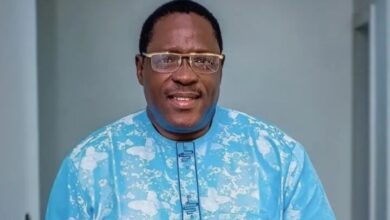
Appointment of judges in Nigeria is arbitrary- Chijioke, ex-VP, ECOWAS court
‘Bello: EFCC is not a trial institution, they should present their facts before the court’

A former vice president of the ECOWAS Court of Justice, Justice Nwoke Chijioke, said the appointment of judges in Nigeria is arbitrary. Chijioke, who said this on Channels TV ‘Politics Today’ monitored by Linus Aleke, added that the judiciary needs comprehensive reform in all aspects of its operation
Do you agree with the Chief Justice of the Federation that Nigerians are not getting the justice they deserve?
I think that his statement settles it all because the generality of Nigerians has lost confidence in the judiciary. I think that the judiciary needs comprehensive reform in all aspects of its operation, for instance; the issuance of these ex parte order. Justice is only done when there is a fair hearing. But in terms of ex parte order, only one party is listened to and everything is determined based on his own perhaps dispositions. When we were in law school, we were taught that ex parte orders should be used sparingly, only in exceptional situations. A situation of emergency, but the best is to put the other party on notice so that he will be in a position to answer all the allegations that are contained.
Why is it that politicians can shop for ex-parte orders from different courts across the country for and against, in one case?
It is a very great concern for the judiciary in Nigeria. It is even more disturbing when the orders emanate from courts of coordinate jurisdiction. In other words, they have the same powers, one is not a supervisor to the other. Now, when there is a conflict, in other words, a court of coordinate jurisdiction issues one order and another one counters it, it brings what I will call confusion and is very opprobrious in the judiciary. In other words, it leaves the parties with a question, which order is to be obeyed? By the Latin maxim omnia praesumuntur rite et solemniter esse acta, every conduct by an authority is presumed to be legal and all the things that are supposed to be complied with have been complied with. So, the two orders are binding. But when it comes to questions where there are conflicting orders, it becomes a question of which one will you comply with.
In your opinion, is the NJC up and doing in its regulatory functions?
Well, the NJC, also consists of human beings and again there is a question of knowledge as you rightly observed. Is it not better to put the other party on notice, on a particular motion, an interlocutory motion, where the two parties come before the court at the same time, and when they do that, there may be no possibility of one of the parties going to another court to institute an action on same matter if both of them are at a particular court.
Can these legal shenanigans be stopped by the judges?
Of course, it can be stopped by the judges. It can be regulated and controlled by the NJC, through sanctioning of judges. When you sanction judges who issue these orders by exercising coordinate jurisdiction, perhaps it could be a preventative measure for other judges in subsequent cases not to toe the same line.
Where do we begin in the proposed reform of our justice system?
I think that it should begin with the appointment of judges. Judges on this day are appointed arbitrarily. There should be a procedure through which those who aspire to be judges follow. For example, in the ECOWAS system, there is a procedure that the Chief Justices of the Federation of ECOWAS member states follow. When ECOWAS advertises for those positions, any person who is interested in being a judge goes through that position of making an application and it is left for those luminaries to select the wheat from the chaff. And there was a competitive interview from the applicants of member states who are supposed to produce judges. But in the Nigerian situation, it appears more often than not, it is done through the back door. It is not open and it is not transparent.
Is it then reserved for cronies and relations?
Yes, if your father is a judge today, you are likely to be a judge tomorrow. Or your husband is a judge your brother is a governor your brother is a Senate President, and so on. When judges who are supposed to be impartial are recruited in this manner, then the fulcrum of justice is destroyed. The basic thing is that justice is first rooted in confidence and confidence is destroyed when right-thinking members of society go about, thinking that the judge is biased.
What is your opinion on the growing crisis between EFCC and the immediate past governor of Kogi State?
All these challenges are because of what I will call the media trail. An institution of justice should be in the position, especially when you are the investigator to carry out a discreet investigation, and not involve yourself in a media trial. For example, the EFCC chairman’s interview with the media on this subject matter was unnecessary. It was uncalled for, in the sense that you do not need to accord any privilege to Yahaya Bello. The law does not require giving privileges to suspected criminals. The law does not necessarily need, especially in situations of this nature, in corruption cases, to make an arrest. You don’t need to bring him into custody because more often than not, corruption cases are determined by documentary evidence. If you establish a prima facie case, and you have evidence to that effect, why don’t you file the case in court and serve the accused person? Why would you in the first instance advertise and publicise the case that is an unfair hearing?
This matter started when Bello was in office, is that not so?
Yes, it is so but he enjoyed immunity then.
Why would he not present himself to the EFCC?
Here again are the questions. Must the police arrest you and put you in custody before you are tried especially in situations like this? Must you be arrested and incarcerated? That is the challenge of our institutions. If I have sufficient evidence to try you, I establish a prima facie case and go to court.
Former governors were invited by the same EFCC, they honoured it and today they are freely walking the streets after questioning and investigation, why is Bello unwilling to submit himself to the authority?
If you are accused of committing an offence, you still enjoy certain constitutional protection, in terms of your fundamental human rights. That is why the law says that if any person feels that his rights are being threatened, not even when they are violated but threatened, he enjoys the right to approach a high court for the enforcement of his fundamental human rights.
Why is Bello running away from the law as if he does not have something to hide?
Well, is he running away? If you think you have a case against the man, charge him to court and present your evidence to convict him.
Do you have a problem with the approach EFCC is adopting in the fight against graft in Nigeria?
I have a problem with that exactly.
Are they doing anything illegal?
In the first instance, there is this trial by the media, ordinarily fair hearing includes having being in the position to listen to the other party. Yahaya Bello is an ordinary citizen of this country, even though he was a former governor. Secondly, do you need an ex parte order of court? I think that in the administration of the Criminal Justice Act, you need an ex parte order for arresting a person if you are going to keep him beyond the constitutional provisions of about 48 hours. You cannot incarcerate anybody beyond 48 hours.
What is your opinion on the withdrawal of EFCC’s appeal against the former Kogi governor?
Is it the appeal given with the respect to Kogi State High Court? Should EFCC have appealed against an ex parte order for the enforcement of fundamental human rights without hearing the substantive interlocutory application?
You seem to have issues with the manner EFCC is prosecuting its corruption cases
The manner is inappropriate, they may have the right to do what they are doing, but is it appropriate?
What of those who obstructed the arrest of the former governor?
I don’t want to comment on those matters that I don’t have foreknowledge of because, in the first instance, it was reported that they stopped the arrest of the former governor. I would not be in the position to speak on that because I was not there.
Are you worried about the technicality in this case?
I am worried so much because, in all the cases prosecuted by EFCC, how many had they been convicted of adopting the same process? These appear to be a recurring decimal in their operations. A typical example is that of the former Attorney General of the Federation, Bello Adoke.
What do you think EFCC would have done?
Let us look at the trial of the former President of the United States of America, Mr Donald Trump. The Justice Department made their investigation, collated their documents, and went to court. When you establish a prima facie case, what is wrong with filing the charges and serving the accused? Why go through the rigor of doing ABC, what of others who were arrested and tried?
EFCC said it has enough evidence to nail the former governor but he is invading arrest, what do you think?
EFCC is not a trial institution, they only have a fact. They should present this fact before a court. It is for the court to determine. It is not for them to present the evidence to the media which is the case in this matter. I am talking from the point of view of the law, not politics. What the EFCC is doing is akin to persecution and not prosecution.
How can this be resolved?
Charge him to court and let the trial begin, because once the matter goes before the court, the EFCC has no business in investigating any other thing.