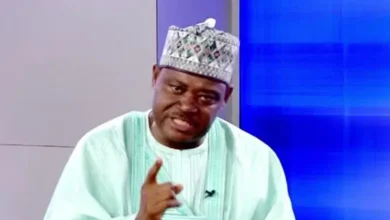
A former Taraba governorship aspirant and ex-member of the All Progressives Congress National Working Committee, Senator Abubakar Yusuf, has faulted the National Assembly’s refusal to amend the Electoral Act to guarantee real-time transmission of election results. Speaking on Channels Television’s Politics Today monitored by David Lawani, he also assessed budget implementation under President Bola Tinubu, criticised deficit financing and rising governance costs, and weighed in on NNPCL transparency and allegations of religious persecution
Why has the Tinubu administration struggled with budgeting? We have seen budgets for 2024 and 2025, and now projections for 2026, yet performance has remained poor. What, in your view, is responsible?
One of the basic problems is that, before you prepare a budget, you must plan. We have been operating on the envelope system, where you budget before you properly plan. That has been a major issue. If you give me an envelope that is inconsistent with my development plan, whether it is higher or lower, I cannot effectively implement what I have set out to do. So once planning does not come first, failure becomes inevitable. If you do not plan well, the budget will fail.
Are you suggesting that the envelope budgeting system should be scrapped entirely?
Yes, I have always maintained that position, even during my time in the Senate. The envelope system is not suitable for us, and it has not worked effectively. Over the years, we have not been able to implement up to 60 per cent of our capital budgets. We should jettison it. When you make a budget without a practical, efficient system for releasing funds for projects, it becomes a problem. The issue of releases has always been serious. If you make a budget and the releases are very poor, there is no way the budget will yield results. That failure could be due to a lack of capacity, poor administrative attitude, or what I describe as ‘sludging’. I have spoken about this many times. It remains a major problem. Ideally, our budgets should be in surplus, but instead we operate with deficit financing year after year, largely due to massive ‘sludging’.
You mentioned ‘sludging’. What exactly do you mean by that?
‘Sludging’ means spending money on things that are not truly necessary. For example, every year in the civil service, allocations are made for computers, vehicles, and similar items. But you do not need to buy computers every single year to function effectively. Many other items are repeatedly budgeted for, even when they are not required. That is what I refer to as ‘sludging’, spending on what is not needed.
So, is the high cost of governance at the heart of the problem?
Yes, exactly. A budget should be about purchasing what you genuinely need. As long as you avoid unnecessary spending, you can control costs. But there are high operating costs for ministries and agencies, including spending on unused items. It amounts to squandering public funds on things the government does not require. That is what ‘sludging’ is about: buying what you do not need.
What is your assessment of the Steve Oronsaye Report? This administration pledged to cut costs, yet the government appears larger, with more ministries and appointees. Isn’t that contradictory?
Running the government in this country has become very expensive. The Steve Oronsaye Report highlighted that the government has expanded and continues to fund institutions that may not be necessary. In some cases, institutions with similar mandates should be consolidated to reduce duplication. Many agencies require review, even at the state level. For example, while some have argued against the Fiscal Responsibility Commission, it is essential to promote integrity and responsibility in public finance. We should also not focus only on the federal budget. There is significant splodging at the state and local government levels. In fact, when you aggregate sub-national budgets, they can even be higher than the federal budget.
Does that suggest a lack of seriousness in our fiscal culture?
We are not serious in the sense that I have always argued for a more cooperative and consultative federal system. There should be a strong link between federal and state actions. Until we establish that, we will continue to have problems. Yes, we have the National Economic Council, but who really dictates the direction? It is largely the federal government. Sometimes, instead of focusing on projects aligned with their own resources and priorities, states try to replicate what other states, such as Lagos, are doing, even when they do not have the same revenue base. They end up borrowing to pursue projects that may not be sustainable. Without comprehensive coordination between federal and state fiscal policies, budget deficits will persist.
Are you implying that the administration’s economic model, often called ‘Tinubu-nomics’, is not working?
For me, it is not working as expected. Even as a member of the APC, I would be the last person to conceal the reality. Within their policy framework, they may be doing their best, but it is not a framework that suited Nigeria when President Tinubu assumed office. There was already economic fallout, and there was insufficient preparation. In my view, the President should not have announced the removal of the fuel subsidy on Inauguration Day without first establishing the necessary structures. If a subsidy is considered corrupt, mechanisms should first be developed to address it. He should have met with his cabinet, ministers, and advisers to properly manage the transition before making such a declaration.
Could these economic challenges affect your party’s electoral prospects?
It may or may not. It could be that significant ground has been lost by failing to implement the right policies to stabilise and grow the economy. However, there is still about a year left. If the government is serious and ready to make necessary adjustments, there is still room to improve the situation.
What is your view on the transparency of the NNPCL, particularly regarding claims that the refineries are operational?
Since I joined the Senate about ten years ago, we have consistently engaged with NNPCL to demand clearer explanations of its operations. It has always been opaque. The processes have largely remained hidden from public scrutiny. The system has not significantly changed over the years. If the structure remains the same, the transparency challenges persist. It is important to remember that NNPCL is a federation entity, not merely a federal government agency, so its accountability should reflect that broader ownership.
What is your reaction to the United States’ designation concerning Senator Kwankwaso and the broader situation?
Personally, we need to sit down and understand ourselves better as a country. Nigeria is diverse. I am a Fulani and a Muslim, but that does not make me a supporter of genocide. In 2017, about 900 Fulanis were reportedly killed on the Mambila Plateau, and they were Muslims as well. These conflicts are complex and not simply about one group targeting another. If allegations are being made, there must be empirical evidence. Those accused should be taken to court so the judiciary can determine the truth. For example, many Boko Haram suspects have reportedly been arrested—how many of them have actually been prosecuted?
There have been calls to freeze the accounts of Miyetti Allah and Senator Kwankwaso over alleged systemic persecution. What is your view?
As I said earlier, we need to carefully study and understand the issues before taking such actions. When similar claims were made in places like Iraq and Libya, some consequences followed misjudgements. Miyetti Allah is essentially a cattle breeders’ association in Nigeria. Any decision to freeze accounts or impose sanctions must be based on a thorough investigation and clear evidence, not assumptions.
Do Christians enjoy freedom of worship in Northern Nigeria?
They do. There are many Christians in states such as Taraba, Benue, parts of Kogi, Kwara, and Plateau. The situation varies across regions, and it is not accurate to generalise the entire north. Americans may interpret developments as Christian annihilation, but the context is more complex. We need to examine the facts carefully.
Some argue that there is systemic persecution of Christians. Do you agree?
What systemic persecution? Who is persecuting whom? I am not saying that people are not being killed or that violence does not occur. What I am saying is that we must understand the broader governance and security failures affecting the country. I come from the Mambila Plateau, where Muslims and Christians live together peacefully. For any foreign government to take a strong position, it must thoroughly study and understand the situation on the ground.
What is your view on the Senate’s handling of amendments to the Electoral Act, particularly regarding real-time transmission of results?
The Senate performed poorly. They should either amend the law properly, or we risk reverting to the 2022 situation. If the President wants real-time transmission of election results, we must define what real-time means: instantaneous transmission. Today, financial transactions are carried out in real time across many parts of Nigeria. So why should election results be different? By failing to strengthen that provision, the Senate risks taking us backwards instead of improving electoral integrity.