By Babs Oyetoro
President Adama Barrow of The Gambia has acknowledged Nigeria’s growing influence in the development of higher education in his country, praising the Nigerian Technical Aid Corps (NTAC) for what he described as sustained support that has helped strengthen critical sectors, particularly tertiary education.
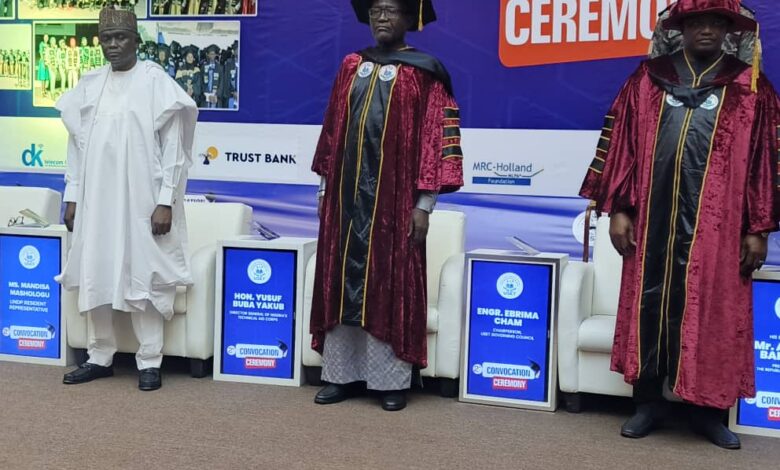
Barrow spoke in Banjul during the second combined
convocation ceremony of the University of Applied Science, Engineering and
Technology (USET), where 951 students received degrees, diplomas and
certificates across various disciplines.
The Gambian leader used the occasion to restate his
country’s appreciation to Nigeria for deploying skilled professionals under the
NTAC scheme, saying the initiative has delivered tangible results in national
development.
According to him, Nigerian experts serving in The Gambia
have made significant contributions to the growth of higher education and other
strategic sectors.
“We remain profoundly grateful to the Government and
people of Nigeria for their sustained support through the Nigerian Technical
Aid Corps Scheme,” Barrow said.
The convocation, themed “Innovation for Impact:
Science, Skills and Sustainable Development,” brought together government
officials, diplomats, academics and development partners from across the
region.
Representing President Bola Tinubu at the event,
Director-General of the Nigerian Technical Aid Corps, Rt. Hon. Yusuf Buba Yakub
reaffirmed Nigeria’s commitment to deepening bilateral cooperation with The
Gambia through technical assistance, capacity building and knowledge transfer.
Yakub said the Tinubu administration remained committed to
deploying skilled Nigerian professionals to support development efforts across
Africa.
“President Bola Ahmed Tinubu remains committed to
strengthening Nigeria’s development cooperation with The Gambia through
strategic technical assistance, knowledge transfer, capacity building and the
deployment of skilled Nigerian professionals,” he said.
A major highlight of the ceremony was the growing prominence
of Nigerian academics in key leadership positions within Gambian universities,
a development officials say reflects the long-term impact of the Technical Aid
Corps programme.
Among those occupying strategic roles are USET
Vice-Chancellor, Prof. Nazmat Surajudeen-Bakinde; Deputy Vice-Chancellor
(Academic Affairs), Prof. Ado Yusuf Abdulfatah; Director of Academic Planning
and Quality Assurance, Prof. David Gundu; Director of Grants and Research, Prof.
Akinlabi; and Deputy Vice-Chancellor (Academic) at the University of The
Gambia, Prof. Kayode Adekeye.
Their appointments, observers noted, underscore the
influence of Nigerian expertise in shaping The Gambia’s academic landscape.
In her remarks, Surajudeen-Bakinde, herself a beneficiary of
the NTAC programme, credited Nigeria for helping to transform tertiary
education in The Gambia.
She said Nigerian professionals had played a vital role in
building institutional capacity and strengthening academic standards within the
country’s universities.
The NTAC Director-General also commended Gambian authorities
for sustaining the partnership, particularly Minister of Higher Education,
Research, Science and Technology, Prof. Pierre Gomez, whom he described as a strong
advocate of educational cooperation and human capital development.
The university also honoured outstanding students with
academic excellence awards, while special recognition awards were presented to
individuals who contributed significantly to educational advancement.
Yakub was among the recipients, receiving an award from
President Barrow in recognition of NTAC’s contributions to capacity building
and educational development in The Gambia.
The ceremony reinforced the growing importance of the Nigerian
Technical Aid Corps as a key instrument of Nigeria’s foreign policy, with its
footprint increasingly visible in education, institutional development and
regional cooperation across Africa.